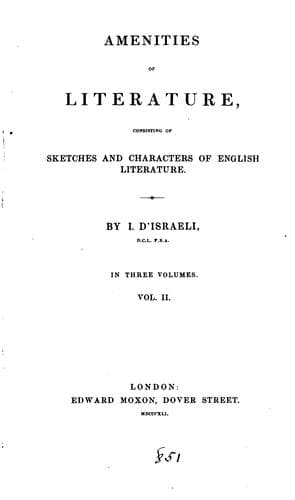
Amenities of Literature: Consisting of Sketches and Characters of English LiteratureDisraeli, Isaac
History
Amenities of Literature: Consisting of Sketches and Characters of English Literature
Disraeli, Isaac
Authors, English -- Biography; English literature -- History and criticism; Great Britain -- Intellectual life
[1] After Godwin had sent to press his biography of Chaucer, a
deposition on the poet's age in the Herald's College detected the
whole erroneous arrangement: as the edifice so ingeniously
constructed had fallen on the aërial architect, he alleged truly that
the deposition "contradicted the received accounts of all the
biographers;" in fact, they had repeated original misstatements. The
appendix, therefore, to the history of this modern biographer stands
as a perpetual witness against its authenticity;--there are some
histories to which an appendix might prove to be as fatal. In this
dilemma, our bold sophist was "absurd and uncharitable enough" to add
one more conjecture to his "Life of Chaucer,"--that "the poet, from a
motive of vanity, had been induced _to state on oath_ that he was
about forty when, in truth, he was fifty-eight!"--Hippisley's
"Chapters on Early English Literature," 85.
[2] It has been alleged by more than one writer, that this mysterious
affair relates to the election for the mayoralty of John of
Northampton, a Wickliffite and a Lancastrian. But Mr. Turner, whose
researches are on a more extended scale than any of his predecessors,
truly observes that--"There are other periods besides the one usually
selected to which the personal evils which Chaucer complains of are
applicable."--"Hist. of England," v. 296. It is as likely to have
occurred when Nicholas Brambre, a confidential partisan of government
in the City, appointed to the mayoralty by his party, caught "the
Freemen" by ambushes of armed men, and turned the Guildhall into a
fortress. At such a time "Free Elections" might have been considered
by Chaucer as something "noble and glorious for all the people."
[3] Dreams.
[4] Better.
[5] Autobiography of an Opium-Eater.--"Tait's Mag." August, 1835.
[6] Coleridge's "Table-Talk."
[7] So unskilful or so incurious was Warburton in the language of our
ancient poets, that in his notes on Pope he quotes the following
lines of Chaucer--
"Love wol not be _constreined_ by maistrie.
Whan maistrie cometh, the _God_ of love anon
_Beteth_ his wings, and _farewel_, he is gon"--
from Urry's edition, in which they appear thus transformed and
corrupted:
Love will not be _confined_ by maisterie.
When maisterie comes, the _Lord_ of love anon
_Flutters_ his wings, and _forthwith_ is he gone.
[An excellent example of the superior vigour of Chaucer may be seen
in an original passage of his "Palamon and Arcite," contrasted with
Dryden's tamer modernization of the same, in "Curiosities of
Literature," vol. ii. p. 107.--ED.]
Public-domain text, read in full here on John Shaqi.
Reviews
Reviews
No reviews yet
Be the first to share your thoughts on this work.
Elsewhere in the archive
Join the Discussion
Join the discussion
Sign in to leave a comment or review.
Sign InorCreate an account