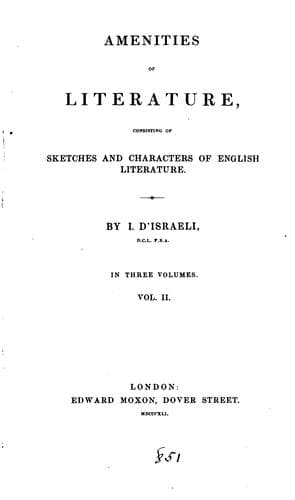
Amenities of Literature: Consisting of Sketches and Characters of English LiteratureDisraeli, Isaac
History
Amenities of Literature: Consisting of Sketches and Characters of English Literature
Disraeli, Isaac
Authors, English -- Biography; English literature -- History and criticism; Great Britain -- Intellectual life
It is not less curious to observe that, at a time when the literary
celebrity of the monachal scribe could hardly pass the boundaries of the
monastery, and the monk himself was restricted from travelling, bound by
indissoluble chains, yet this lone man, as if eager to enjoy a literary
reputation, however spurious, was not scrupulous in practising certain
dishonest devices. Before the discovery of printing, the concealment of
a manuscript for the purpose of appropriation was an artifice which, if
we may decide by some rumours, more frequently occurred than has been
detected. Plagiarism is the common sin of the monkish chronicler, to
which he was often driven by repeating a mouldy tale a hundred times
told; but his furtive pen extended to the capital crime of felony. I
shall venture to give a pair of literary anecdotes of monkish writers.
Matthew of Paris, one of these chroniclers, is somewhat esteemed, and
Matthew of Westminster is censured, for having copied in his "Flores
Historiarum" the other Matthew; but we need not draw any invidious
comparison between the two Matthews, since Matthew the first had himself
transcribed the work of Roger the Prior of Wendover. The famous
"Polychronicon," which long served as a text-book for the encyclopædic
knowledge of the fourteenth century, has two names attached to it, and
one, however false, which can never be separated from the work,
interwoven in its texture. This famed volume is ascribed to Ranulph, or
Ralph Higden of St. Werberg's Monastery, now the Cathedral of Chester.
Ralph, that he might secure the tenure of this awful edifice of
universal history for a thousand years, most subdolously contrived that
the initial letter of every chapter, when put together, signified that
Ralph, a monk of Chester, had compiled the work. Centuries did not
contradict the assumption; but time, that blabber of more fatal secrets
than those of authors, discovered in the same monastery that another
brother Roger had laboured for the world their universal history in his
"Polycratica Temporum." On examination, the truth flashed! For lo! the
peccant pen of Ralph had silently transmigrated the "Polycratica" into
the "Polychronicon," and had only laid a trap for posterity by his
treacherous acrostics![2]
These universal chroniclers usually opened, _ab initio_, with the
Creation, dispersed at Babel reach home, and paused at the Norman
Conquest. This was their usual first division; it was a long journey,
but a beaten path. Whatever they found written was history to them, for
they were without means of correcting their aptitude for credence. Their
anachronisms often ludicrously give the lie to their legendary
statements.
Public-domain text, read in full here on John Shaqi.
Reviews
Reviews
No reviews yet
Be the first to share your thoughts on this work.
Elsewhere in the archive
Join the Discussion
Join the discussion
Sign in to leave a comment or review.
Sign InorCreate an account