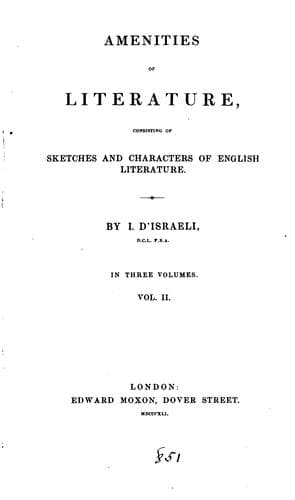
Amenities of Literature: Consisting of Sketches and Characters of English LiteratureDisraeli, Isaac
History
Amenities of Literature: Consisting of Sketches and Characters of English Literature
Disraeli, Isaac
Authors, English -- Biography; English literature -- History and criticism; Great Britain -- Intellectual life
Most of these monastic writers composed in a debased Latinity of their
own, bald and barbarous, but which had grown up with the age; their
diction bears a rude sort of simplicity. Yet though they were not
artists, there were occasions when they were inevitably graphic--when
they detail like a witness in court. These writers have been lauded by
the gratitude of antiquaries, and valued by philosophical historians. A
living historian has observed of them, that "nothing can be more
contemptible as compositions; nothing can be more satisfactory as
authorities." But it is necessary that we should be reminded of the
partial knowledge and the partial passions of these sources of our
earlier modern history. Lift the cowl from the historiographers in their
cells recording those busy events in which they never were busied,
characterising those eminent persons from whom they were far removed;
William of Malmesbury, not one of the least estimable of these writers,
confesses that he drew his knowledge from public rumours, or what the
relaters of news brought to them.[3] In some respects their history
sinks to the level of one of our newspapers, and is as liable to be
tinged with party feelings. The whole monastery had as limited notions
of public affairs as they had of the kingdom itself, of which they knew
but little out of their own county.
No monastic writer, as an historian, has descended to posterity for the
eminence of his genius, for the same stamp of mind gave currency to
their works. Woe to the sovereign who would have clipt their wings! then
"tongues talked and pens wrote" monkish. There was a proverb among them,
that "The giver is blessed, but he who taketh away is accursed." None
but themselves could appeal to Heaven, and for their crowned slaves they
were not penurious of their beatitude. They knew to crouch as well as to
thunder. They usually clung to the reigning party; and a new party or a
change of dynasty was sure to change their chronicling pen. HALL, the
chronicler of Henry the Eighth, at the first moment when it was
allowable to speak distinctly concerning these monkish writers,
observed, "These monastical persons, learned and unliterate, better fed
than taught, took on them to write and register in the book of fame the
arts, and doings, and politic governance of kings and princes." It seems
not to have occurred to the chronicler of Henry the Eighth that, had not
those monks "taken on them to write and register," we should have had no
"Book of Fame." It is a duty we owe to truth to penetrate into the
mysteries of monkery, but the monks will always retain their right to
receive their large claims on our admiration of their labours.
Public-domain text, read in full here on John Shaqi.
Reviews
Reviews
No reviews yet
Be the first to share your thoughts on this work.
Elsewhere in the archive
Join the Discussion
Join the discussion
Sign in to leave a comment or review.
Sign InorCreate an account