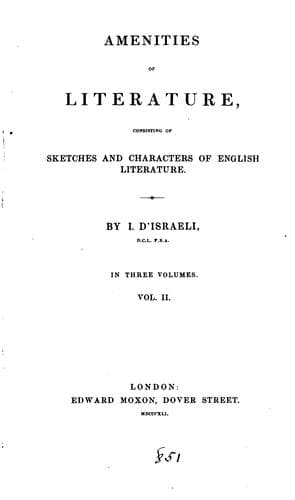
Amenities of Literature: Consisting of Sketches and Characters of English LiteratureDisraeli, Isaac
History
Amenities of Literature: Consisting of Sketches and Characters of English Literature
Disraeli, Isaac
Authors, English -- Biography; English literature -- History and criticism; Great Britain -- Intellectual life
The people of Europe, who had no other knowledge of languages than their
own uncultivated dialects, seem to have possessed what, if we may so
dignify it, we would call a fugitive literature of their own. It is
obvious that the people could not be ignorant of the important
transactions in their own land; transactions in which their fathers had
been the spectators or the actors, the sons would perpetuate by their
traditions; the names of their heroes had not died with them on the
battle-field. Nor would the villain's subjection to the feudal lord
spoil the merriment of the land, nor dull the quip of natural
facetiousness.
Before the people had national books they had national songs. Even at a
period so obscure as the days of Charlemagne there were "_most ancient
songs_, in which the acts and wars of the old kings were sung." These
songs which, the secretary of Charlemagne has informed us, were
sedulously collected by the command of that great monarch, are described
by the secretary, according to his classical taste, as _barbara et
antiquissima carmina_; "barbarous," because they were composed in the
rude vernacular language; yet such was their lasting energy that they
were, even in the eighth century, held to be "most ancient," so long had
they dwelt in the minds, of the people! The enlightened emperor had more
largely comprehended their results in the vernacular idiom, on the
genius of the nation, than had the more learned and diplomatic
secretary. It was an ingenious conjecture, that, possibly, even these
ancient songs may in some shape have come down to us in the elder
northern and Teutonic romances, and the Danish, the Swedish, the
Scottish, and the English popular ballads. The kindling narrative, and
the fiery exploits which entranced the imagination of Charlemagne,
mutilated or disguised, may have framed the incidents of a romance, or
been gathered up in the snatches of old wives' tales, and, finally, may
have even lingered in the nursery.
Public-domain text, read in full here on John Shaqi.
Reviews
Reviews
No reviews yet
Be the first to share your thoughts on this work.
Elsewhere in the archive
Join the Discussion
Join the discussion
Sign in to leave a comment or review.
Sign InorCreate an account