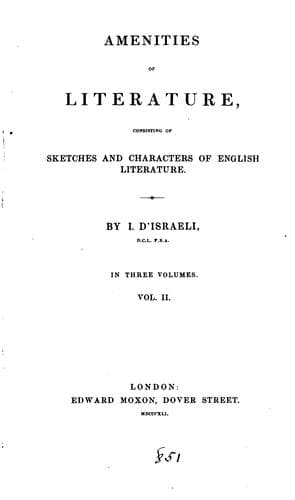
Amenities of Literature: Consisting of Sketches and Characters of English LiteratureDisraeli, Isaac
History
Amenities of Literature: Consisting of Sketches and Characters of English Literature
Disraeli, Isaac
Authors, English -- Biography; English literature -- History and criticism; Great Britain -- Intellectual life
Our miserable populace had poets for themselves, whose looser carols
were the joy of the streets or the fields. Unfortunately we only learn
that they had such artless effusions, for these songs have perished on
the lips of the singers. The monks were too dull or too cunning to
chronicle the outpourings of a people whom they despised, and which
assuredly would have often girded them to the quick. A humorous satire
of this kind has stolen down to us in that exquisite piece of drollery
and grotesque invention, "The Land of Cokaigne."[1] They had historical
ballads which were rehearsed to all listeners; and it was from these
"old ballads, popular through succeeding times," that William of
Malmesbury tells us that "he learned more than from books written
expressly for the information of posterity," though he will not answer
for their precise truth. They had also political ballads. A memorable
one, free as a lampoon, made by one of the adherents of Simon de
Montfort, Earl of Leicester, in the fugitive day of his victory in 1264,
occasioned a statute against "slanderous reports or tales to cause
discord betwixt king and people," a spirit which by no means was put
down by that enactment.[2] This was a ballad sung to the people, as
appears by the opening line,--
Sitteth all stille, and harkeneth to me!
This ballad strikingly contrasts with another of unnerving dejection,
after the irreparable defeat of the party, and the death of the Earl of
Leicester, which, it is remarkable, is written in French, having been
probably addressed solely to that discomfited nobility who would
sympathise with the lament.[3]
The people, or the inferior classes of society, who despised the courtly
French then in vogue, formed such a multitude, that it was for them that
ROBERT of GLOUCESTER wrote his Chronicle, and that ROBERT of BRUNNE
translated the Chronicle of Peter Langtoft, and a volume of recreative
tales from the French. The people even then were eager readers, or, more
properly, auditors; and this further appears in the naïveté of our
rhymer's prologue to this Chronicle. The monk tells us, that this story
of England which he now shows in English, is not intended for the
learned, but the illiterate; not for the clerk, but the layman;
Not for the lerid, but the lewed;[4]
and he describes the class, "they who take solace and mirth when they
sit together in fellowship," and deem it "wisdom for to witten" (to
know)
The state of the land, and haf it written.
The Hermit of Hampole expressly wrote his theological poems for the
people, for those who could understand only English.
Public-domain text, read in full here on John Shaqi.
Reviews
Reviews
No reviews yet
Be the first to share your thoughts on this work.
Elsewhere in the archive
Join the Discussion
Join the discussion
Sign in to leave a comment or review.
Sign InorCreate an account