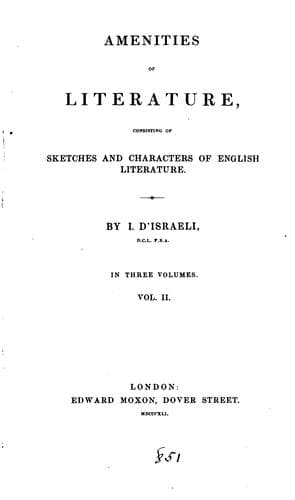
Amenities of Literature: Consisting of Sketches and Characters of English LiteratureDisraeli, Isaac
History
Amenities of Literature: Consisting of Sketches and Characters of English Literature
Disraeli, Isaac
Authors, English -- Biography; English literature -- History and criticism; Great Britain -- Intellectual life
At a period when we glean nothing from any literature of the people, we
find that it had a positive existence; for two chronicles and a
collection of tales and theological poems were furnished for them in
their native idiom, by writers who unquestionably sought for celebrity.
The people, too, had what in every age has been their peculiar
property,--all the fragmentary wisdom of antiquity in those "Few words
to the Wise," so daily useful, or so apt in the contingencies of human
life; proverbs and Æsopian fables, delightedly transmitted from father
to son. The memories of the people were stored with short narratives;
for a startling tale was not easily forgotten. They had songs of trades,
appropriated to the different avocations of labourers. These were a
solace to the solitary task-worker, or threw a cheering impulse when
many were employed together. Such HALL aptly describes as
Sung to the wheel, and sung unto the payle.[5]
These songs are found among the people of every country; and these
effusions were the true poetry of the heart, which kept alive their
social feelings. The people had even the greater works brought down for
them to a diminutive size; the lays of minstrelsy were usually fragments
of the metrical chronicles, or a disjointed tale from some romance;[6]
such as the popular Fabliaux, which form the amusing collection of Le
Grand.
These proverbs and these fables, these songs and these tales, all these
were a library without books, till the day arrived when the people had
books of their own, open to their comprehension, and responding to their
sympathies. That this traditional literature was handed down from
generation to generation appears from the circumstance, that hardly had
the printing-press been in use when a multitude of "the people's books"
spread through Europe their rude instruction or their national humour.
They were even rendered more attractive by the expressive woodcuts which
palpably appealed to a sense which required no "cunning" to comprehend.
Their piety and their terror were long excited by that variety of Satan
and his devils, which were exhibited to their appalled imaginations--the
the mouth of hell gaping wide, and the crowd of the damned driven in by
the flaming pitchforks. "The Calendar of Shepherds," originally a
translation from the French, was a popular handbook, and rich were its
contents--a perpetual almanac, the saints' days, with the signs of the
zodiac, a receptacle of domestic receipts, all the wisdom of proverbs,
and all the mysteries of astrology, divinity, politics, and geography,
mingled in verse and prose. It was the encyclopædia for the poor man,
and even for some of his betters.
Public-domain text, read in full here on John Shaqi.
Reviews
Reviews
No reviews yet
Be the first to share your thoughts on this work.
Elsewhere in the archive
Join the Discussion
Join the discussion
Sign in to leave a comment or review.
Sign InorCreate an account