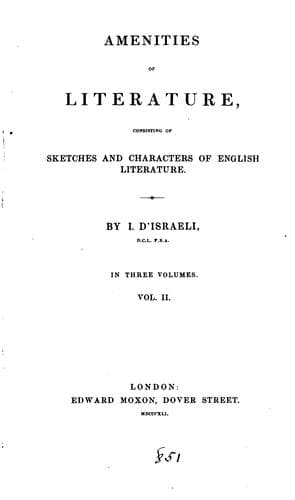
Amenities of Literature: Consisting of Sketches and Characters of English LiteratureDisraeli, Isaac
History
Amenities of Literature: Consisting of Sketches and Characters of English Literature
Disraeli, Isaac
Authors, English -- Biography; English literature -- History and criticism; Great Britain -- Intellectual life
[6] Warton draws his knowledge from Rowland's "Mona Antiqua;" Geoffry
of Monmouth would have extended his inquiry. Camden, judicious as he
was, has actually bestowed the kingdom, as well as the princess, on
this Roman general; and Gibbon has sarcastically noticed that Camden
has been authority for all "his blind followers." The source of this
sort of history lies in the volume of the "Monk of Monmouth," where
Gibbon might have found the number of the numerous army of Maximus.
Rowland's "Mona Antiqua Restaurata" is one of the most extraordinary
pieces of our British Antiquities. It is written with the embrowned
rust of our old English Antiquaries, where nothing on a subject seems
to be omitted; but our author, unlike his contemporary antiquaries,
is sceptical even on his own acquisitions; he asserts little and
assumes nothing. One may conceive the native simplicity of an author,
who having to describe the Isle of Anglesey, opens his work with the
history of Chaos itself, to explain by the division of land and water
the origin of islands. I have heard that this learned antiquary never
travelled from his native island.
[7] "L'Art de vérifier les Dates," article _Brétagne_, is thrown into
utter confusion. It seems, however, to indicate that there were many
migrations; but all is indistinct or uncertain.
[8] Verstegan has finely engraved these idols in his "Restitution,"
so delighted was this Teutonic Christian with these hideous
absurdities of his pagan ancestors, and so proud of his Saxon
descent.
[9] Turner's "History of England during the Middle Ages," iv. 326.
[10] "Britannia after the Romans." The literary patriotism of Wales
has been more remarkable among humble individuals than among the
squirearchy, if we except the ardent Pennant. Mr. Owen Jones, an
honest furrier in Thames-street, kindled by the love of father-land,
offered the Welsh public a costly present of the "Archæology of
Wales," containing the bardic poetry, genealogies, triads,
chronicles, &c. in their originals: the haughty descendant of the
Cymry disdained to translate for the Anglo-Saxon. To Mr. William Owen
the lore of Cambria stands deeply indebted for his persevering
efforts. Under the name of Meirion he long continued his literal
versions of the Welsh bards in the early volumes of the "Monthly
Magazine;" he has furnished a Cambrian biography and a dictionary.
Public-domain text, read in full here on John Shaqi.
Reviews
Reviews
No reviews yet
Be the first to share your thoughts on this work.
Join the Discussion
Join the discussion
Sign in to leave a comment or review.
Sign InorCreate an account