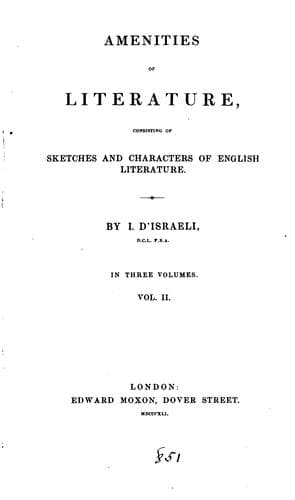
Amenities of Literature: Consisting of Sketches and Characters of English LiteratureDisraeli, Isaac
History
Amenities of Literature: Consisting of Sketches and Characters of English Literature
Disraeli, Isaac
Authors, English -- Biography; English literature -- History and criticism; Great Britain -- Intellectual life
Lord Cromwell was the chief minister through whose mediation these novel
royal grants of houses and lands were distributed. There was evidently
no chance of attention from his lordship without the most open and
explicit offers of the grossest bribery. The Chancellor Audley, in
bargaining with Lord Cromwell for the abbey of St. Osyth, for "some
present trouble in this suit," one day sent twenty pounds, with "my poor
hearty good will, during my life." Perhaps the bribe, though only placed
to account, had not its full weight, as the chancellor does not appear,
in the present instance, to have possessed himself of this abbey,
though, afterwards, with the spoils of two rich monasteries, he built
the most magnificent mansion in England, by which he perpetuated his own
name in the once-famed Audley-End. Sir Thomas Elyot, in soliciting his
lordship's mediation with the king to reward him with "some convenient
portion of the suppressed lands," found it advisable to offer a
conditional promise! "Whatsoever portion of land that I shall attain by
the king's grace, I promise to give to your lordship the first year's
fruits, with my assured and faithful heart and service." All were
offering their hearts and the rest of their lives to Lord Cromwell.
As for the regal dispenser himself, so stupendous was his portion that
it became necessary to found a court never heard of before--"The Court
of Augmentation," an expressive designation, indicating its plenary
character, with its chancellor and its treasurer, and a long routine of
officers, and none too many, "that the king might be justly dealt with,"
says Cowell, "the interpreter," "for all the manors and parks, the
colleges and chantries, and the religious houses which the king did not
sell or give away;" that is, the selected prey which the royal eagle
grasped in his own talons.
We are accustomed to trace the Reformation to Henry the Eighth; but in
verity small are the claims of this sovereign on posterity, for through
all the multiplied ramifications of superstition, nothing under him was
reformed. The other great event of the Reformation--the assumption of
the spiritual supremacy--accorded with the national independence from a
foreign jurisdiction. The policy was English; but it originated in the
private passions of the monarch. Assuredly, had the tiara deigned to nod
to the regal solicitor, then had "the Defender of the Faith" only given
to the world another edition of his book against Luther.
Public-domain text, read in full here on John Shaqi.
Reviews
Reviews
No reviews yet
Be the first to share your thoughts on this work.
Elsewhere in the archive
Join the Discussion
Join the discussion
Sign in to leave a comment or review.
Sign InorCreate an account