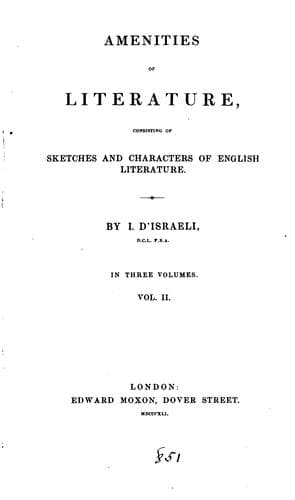
Amenities of Literature: Consisting of Sketches and Characters of English LiteratureDisraeli, Isaac
History
Amenities of Literature: Consisting of Sketches and Characters of English Literature
Disraeli, Isaac
Authors, English -- Biography; English literature -- History and criticism; Great Britain -- Intellectual life
Another incident in which our vernacular literature was remotely
connected, was the calling in of the ancient Rituals, Missals, and other
books of the Latin service, and establishing the book of Common Prayer
in the common language. But the people at large seemed reluctant to
alter their antiquated customs, which habit had long endeared to them.
While they had listened to an unintelligible Mass, they had, from their
childhood, contracted a spirit of devotion. Their fathers had bowed to
the Mass as a holy office from time immemorial; and from their childhood
they had attached to it those emotions of holiness which were not the
less so by their erroneous association of ideas. When their religion
became a mere Act of Parliament, and their prayers were in plain
English, all appeared an affair of yesterday. The church service seemed
no longer venerable, the new priesthood no longer apostolical; and the
giddy populace protested against the common dues exacted by their
neighbour the curate, for their marriages and baptisms and funerals.
They forsook their churches, and even refused to pay tithes.
It is in revolutionary periods that we find men adapted for these rare
occasions; who, had they not lived amid the commotions around them, had
probably not emerged out of the sphere of their neighbours. Such minds
quickly sympathise with popular grievances and popular clamours, and
obtain their reformation, often at the sacrifice of their individual
interest, as if the cause were their appointed vocation. They are
advocates who plead, imbued even by all the prejudices of their clients;
they are organs resounding the fulness of the passions around them: a
character of this order is the true representative of the multitude;
and we listen to all their cries in the single voice of such a man.
And such a man was ROBERT CROWLEY, a universal reformer through Church
and State; whose unwearied industry run the pace of his zeal; whose
declarations were as open as his designs were definite; and whose
resolved spirit pursued its object in every variable form which his
imagination could invent, and which incessant toil never found irksome.
Public-domain text, read in full here on John Shaqi.
Reviews
Reviews
No reviews yet
Be the first to share your thoughts on this work.
Elsewhere in the archive
Join the Discussion
Join the discussion
Sign in to leave a comment or review.
Sign InorCreate an account