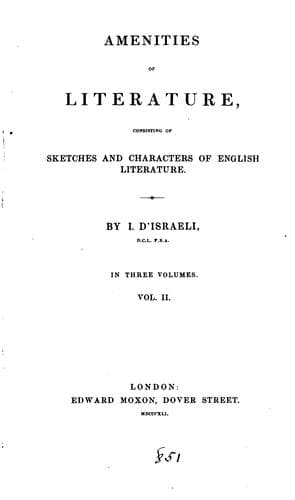
Amenities of Literature: Consisting of Sketches and Characters of English LiteratureDisraeli, Isaac
History
Amenities of Literature: Consisting of Sketches and Characters of English Literature
Disraeli, Isaac
Authors, English -- Biography; English literature -- History and criticism; Great Britain -- Intellectual life
These primeval dramas are not inconsiderable objects in the philosophy
of literary history. In England,[7] and probably throughout Europe, they
long kept their standing; they linger in Italy, and still possess devout
Spain. Not long since at Seville they had their mysteries adapted to the
seasons--the Crucifixion for Good Friday, and the Nativity for
Christmas, and the Creation whenever they chose; and a recent editor of
the plays of Cervantes assures us, that these _Autos Sacramentales_
still form a source of amusement and edification to the pilgrims at the
Shrine of St. Jago de Compostella, which it seems still receives such
visitors.[8]
These scriptural plays were known in England before 1119; they formed
public performances in the metropolis in 1180. They were then confined
to the monasteries, and when the audience required the space, they were
exhibited in churches, and sometimes even in cemeteries. So true it is
that the first theatres were churches and the first actors churchmen.
Some reprobated the sight of the priestly character, or the "fols
clers," "mad clerks," in their grotesque disguisings; if they were
sanctioned by one pope, they were condemned by another. The clergy,
except on some rare occasion, when exhibiting before royalty or
nobility,[9] were at length not reluctant to yield their places to a new
race of performers. In the metropolis they never lost their control over
these representations, for they consigned them to the care of their
inferior brethren, the parish clerks; but in provincial towns it was not
long ere the people themselves discovered that they, with some little
assistance from the neighbouring monasteries, were competent to take
them into their own hands. The honest members of guilds or corporations,
of mechanics and tradesmen, formed themselves into brotherhoods of
actors, ambitious of displaying their mimetic faculty to their
townsfolk. The play had now become the people's play, and the scale of
the representation widened at every point; it was to be acted in an open
plain, and it was to extend sometimes through eight days.[10] Such was
the concourse of spectators, and indeed the performers were themselves
a crowd. All were anxious to show themselves in some part, and such a
play might require nearly a hundred personages. In a miracle-play, the
whole life of a saint, from the cradle to martyrdom, was displayed in
the same piece; the youth, the middle-age, and the caducity of the
eminent personage required to be enacted by three different actors, so
that there were the first, the second, and the third Jacob, to emulate
one another, and provoke bickerings; townsfolk when acting, it appears,
being querulously jealous. Something of scenical illusion was contrived,
and what in the style of the green-room is termed "properties"[11] was
attempted, by the description we find in the directions to the actors,
and by the mischances which occurred to the unpractised performers by
their clumsy machinery.
Public-domain text, read in full here on John Shaqi.
Reviews
Reviews
No reviews yet
Be the first to share your thoughts on this work.
Elsewhere in the archive
Join the Discussion
Join the discussion
Sign in to leave a comment or review.
Sign InorCreate an account