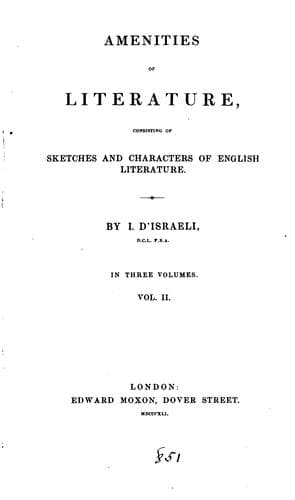
Amenities of Literature: Consisting of Sketches and Characters of English LiteratureDisraeli, Isaac
History
Amenities of Literature: Consisting of Sketches and Characters of English Literature
Disraeli, Isaac
Authors, English -- Biography; English literature -- History and criticism; Great Britain -- Intellectual life
Anglo-Saxon studies have been recently renovated, but unexpected
difficulties have started up. A language whose syntax has not been
regulated, whose dialects can never be discriminated, and whose
orthography and orthoepy seem irrecoverable, yields faithless texts when
confronted; and treacherous must be the version if the construction be
too literal or too loose, or what happens sometimes, ambiguous.
Different anglicisers offer more than one construction.[3]
It is now ascertained that the Anglo-Saxon manuscripts are found in a
most corrupt state.[4] This fatality was occasioned by the inattention
or the unskilfulness of the caligrapher, whose task must have required a
learned pen. The Anglo-Saxon verse was regulated by a puerile system of
alliteration,[5] and the rhythm depended on accentuation. Whenever the
strokes, or dots, marking the accent or the pauses are omitted, or
misplaced, whole sentences are thrown into confusion; compound words are
disjoined, and separate words are jumbled together. "Nouns have been
mistaken for verbs, and particles for nouns."
These difficulties, arising from unskilful copyists, are infinitely
increased by the genius of the Anglo-Saxon poets themselves. The
tortuous inversion of their composition often leaves an ambiguous sense:
their perpetual periphrasis; their abrupt transitions; their pompous
inflations, and their elliptical style; and not less their portentous
metaphorical nomenclature where a single object must be recognised by
twenty denominations, not always appropriate, and too often clouded by
the most remote and dark analogies[6]--all these have perplexed the most
skilful judges, who have not only misinterpreted passages, but have
even failed to comprehend the very subject of their original. This last
circumstance has been remarkably shown in the fate of the heroic tale of
BEOWULF. When it first fell to the hard lot of WANLEY, the librarian of
the Earl of Oxford, to describe "The Exploits of Beowulf," he imagined,
or conjectured, that it contained "the wars which this Dane waged
against the reguli, or petty kings of Sweden." He probably decided on
the subject by confining his view to the opening page, where a hero
descends from his ship--but for a very different purpose from a military
expedition. Fortunately Wanley lauded the manuscript as a "tractatus
nobilissimus," and an "egregium exemplum" of the Anglo-Saxon poetry.
Probably this manuscript remained unopened during a century, when SHARON
TURNER detected the error of Wanley, but he himself misconceived the
design of these romantic "Exploits." Yet this diligent historian
carefully read and analysed this heroic tale. CONYBEARE, who had fallen
into the same erroneous conception, at length caught up a clue in this
labyrinth; and finally even a safer issue has been found, though
possibly not without some desperate efforts, by the version of Mr.
KEMBLE.
Public-domain text, read in full here on John Shaqi.
Reviews
Reviews
No reviews yet
Be the first to share your thoughts on this work.
Join the Discussion
Join the discussion
Sign in to leave a comment or review.
Sign InorCreate an account