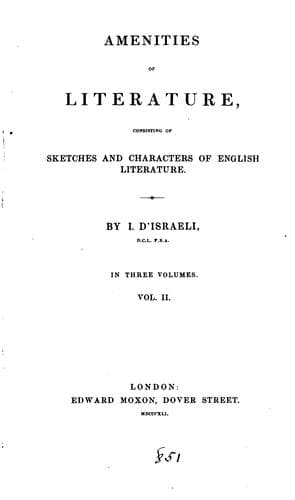
Amenities of Literature: Consisting of Sketches and Characters of English LiteratureDisraeli, Isaac
History
Amenities of Literature: Consisting of Sketches and Characters of English Literature
Disraeli, Isaac
Authors, English -- Biography; English literature -- History and criticism; Great Britain -- Intellectual life
Even the learned in Saxon have not always been able to distinguish this
verse from prose; the verse unmarked by rhyme being written continuously
as prose.[7] A diction turgid and obscure was apparent; but in what
consisted the art of the poet, or the metrical system, long baffled the
most ingenious conjectures. RITSON, in his perplexity, described this
poetry or metre as a "rhymeless sort of poetry, a kind of bombast or
insane prose, from which it is very difficult to be distinguished."
TYRWHIT and ELLIS remained wholly at a loss to comprehend the fabric of
Anglo-Saxon poesy. HICKES, in the fascination of scholarship, had
decided that it proceeded on a metrical system of syllabic quantities,
and surmounted all difficulties by submitting the rhythmical cadences of
Gothic poesy to the prosody of classical antiquity. This was a literary
hallucination, and a remarkable evidence of a favourite position
maintained merely by the force of prepossession.
To what cause are we to ascribe the complex construction of the diction,
and the multiplied intricacies of the metres of the poetry of the
Northmen? Bishop Percy noticed, that the historian of the Runic poetry
has counted up among the ancient Icelandic poets one hundred and
thirty-six different metres. The Icelandic and the Anglo-Saxon are
cognate languages, being both dialects of the ancient Gothic or
Teutonic. The genius of the Danish Scalds often displays in their
Eddas[8] a sublime creative power far out of the reach of the creeping
and narrow faculty of the Saxon, yet the same mechanism regulated both;
the fixed recurrence of certain letters or syllables which constitutes
that perpetual alliteration, which oftener than rhyme gratified the ear
of barbaric poesy, and a metaphorical phraseology or poetical vocabulary
appropriated by the bards, furnishing the adept with phrases when he had
not always ready any novel conceptions. Shall we deem such arbitrary
forms and such artificial contrivances, the mere childishness of tastes,
to have been invented in the wintry years of these climates, to amuse
themselves in their stern solitudes; or rather, may we not consider them
as a mystery of the Craft, the initiation of the Order? for by this
scholarlike discipline in multiplying difficulties the later bards
separated themselves from those humbler minstrels who were left to their
own inartificial emotions.
Public-domain text, read in full here on John Shaqi.
Reviews
Reviews
No reviews yet
Be the first to share your thoughts on this work.
Join the Discussion
Join the discussion
Sign in to leave a comment or review.
Sign InorCreate an account