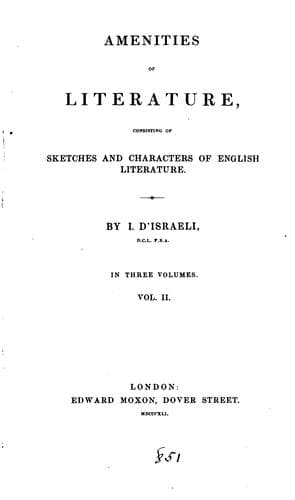
Amenities of Literature: Consisting of Sketches and Characters of English LiteratureDisraeli, Isaac
History
Amenities of Literature: Consisting of Sketches and Characters of English Literature
Disraeli, Isaac
Authors, English -- Biography; English literature -- History and criticism; Great Britain -- Intellectual life
We may lament that the first steps in every revolution are taken in
darkness, and that the reaction of opinions and prejudices is itself
accompanied by errors and prejudices of its own. The bigotry of the new
faith was not inferior to the old. The reforming Archbishop Grindal
substituted the dull and barbarous Palingenius, Sedulius, and
Prudentius, for the great classical authors of antiquity. The
Reformation opened with fanaticism; and men were reformers before they
were philosophers. Had Ascham, a learned scholar, and a man of fine
genius, been blessed with the prescient eye of philosophy, he had
perceived that there was not more papistry in the solemn "Trionfi" of
Petrarch, and not less "honest pastime" in a "merrie tale" of Boccaccio,
than in cock-fighting and dicing; and that with these works the
imagination of the public was gradually stepping out of a supernatural
world of folio legends, into a world of true nature, which led to that
unrivalled era which immortalised the closing century.
We must recollect that the bigotry of the Reformation, or that which
afterwards assumed the form of puritanism, in their absurd notion of the
nature of idolatry attached to every picture and every statue on sacred
subjects, eventually banished the fine arts from England for a long
century, and retarded their progress even to our own days. A curious
dialogue has been preserved by Strype, whose interlocutors are Queen
Elizabeth and a Dean. The Dean having obtained some of those fine German
paintings, those book-miniatures which are of the most exquisite finish,
placed them in her majesty's prayer-book. For this the queen proscribed
the dean, as she did those beautiful illuminations, as "Romish and
idolatrous;" and with a Gothic barbarism, strange in a person with her
Attic taste, commanded the clergy "to wash all pictures out of their
walls." To this circumstance the painter Barry ascribes the backward
state of the fine arts, which so long made us a by-word among the
nations of Europe, and even induced the critical historian of the arts,
Winkelman, to imagine that the climate of England presented an internal
obstruction to the progress of art itself; it was too long supposed that
no Englishman could ever aspire to be an artist of genius. The same
principle which urged Ascham to denounce all Italian books, instigated
his royal pupil "to wash out all pictures;" and even so late as the
reign of George the Third, when the artists of England made a noble
offer, gratuitously to decorate our churches with productions of their
own composition, the Bishop of London forbade the glorious attempt to
redeem English art from the anathema of foreign critics.
Ascham, whose constitutional delicacy often impeded his studies, died
prematurely. The parsimonious queen emphatically rated his value by
declaring, that she would rather have lost ten thousand pounds--no part
of which, during his life, the careless yet not the neglected Ascham
ever shared.
Public-domain text, read in full here on John Shaqi.
Reviews
Reviews
No reviews yet
Be the first to share your thoughts on this work.
Elsewhere in the archive
Join the Discussion
Join the discussion
Sign in to leave a comment or review.
Sign InorCreate an account