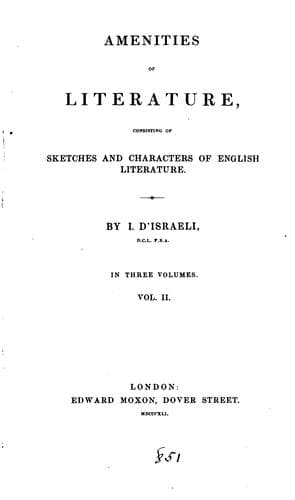
Amenities of Literature: Consisting of Sketches and Characters of English Literature — John Shaqi
Amenities of Literature: Consisting of Sketches and Characters of English LiteratureDisraeli, Isaac
History
Amenities of Literature: Consisting of Sketches and Characters of English Literature
Disraeli, Isaac
Authors, English -- Biography; English literature -- History and criticism; Great Britain -- Intellectual life
[8] See "A Manual of Scandinavian Mythology," by Mr. Grenville
Pigott. 1839. "The Northern Mythology" will be found here not only
skilfully arranged, but its wondrous myths and fables elucidated by
modern antiquaries. It is further illustrated by the translation of
the poem of Oehlenschläger, on "The Gods of the North;" whose genius
has been transfused in the nervous simplicity of the present version.
[9] Such is the critical decision of CONYBEARE, a glorious
enthusiast. "Illustrations of Anglo-Saxon Poetry," by John Josiah
Conybeare. 1826.
The late Mr. Price, the editor of Warton's History, announced an
elaborate work on the Anglo-Saxon poetry. The verse of CONYBEARE and
the disquisitions of PRICE would have completed this cycle of our
ancient poetry. But a fatal coincidence marked the destiny of these
eminent votaries of our poetic antiquity--both prematurely ceasing to
exist while occupied on their works. CONYBEARE has survived in his
brother, whose congenial tastes collected his remains; PRICE, who had
long resided abroad, and there had silently stored up the whole
wealth of Northern literature, on his return home remained little
known till his valued edition of Warton announced to the literary
world the acquisitions they were about to receive. He has left a name
behind him, but not a work, for Price had no fraternal friend.
Since this chapter was written, Mr. Thos. Wright has published "An
Essay on the State of Literature and Learning under the
Anglo-Saxons." It displays a comprehensive view taken by one to whose
zealous labours the lovers of our ancient literature are so deeply
indebted.
CÆDMON AND MILTON.
Cædmon, the Saxonists hail as "the Father of English Song!"
The personal history of this bard is given in the taste of the age.
Cædmon was a herdsman who had never read a single poem. Sitting in his
"beership," whenever the circling harp, that "Wood of Joy!" as the Saxon
gleemen have called it, was offered to his hand, all unskilled, the
peasant, stung with shame, would hurry homewards. Already past the
middle of life, never had the peasant dreamt that he was a sublime poet,
or at least a poet composing on sublime themes, incapable as he was even
of reading his own Saxon.
As once he lay slumbering in a stall, the apparition of a strange man
thus familiarly greeted him:--"Cædmon, sing some song to me!" The
cowherd modestly urged that he was mute and unmusical:--"Nevertheless
thou shalt sing!" retorted the benignant apparition. "What shall I
sing?" rejoined the minstrel, who had never sung. "Sing the origin of
things!" The peasant, amazed, found his tongue loosened, and listened to
his own voice; a voice which was to reach posterity!
Public-domain text, read in full here on John Shaqi.
Reviews
Reviews
No reviews yet
Be the first to share your thoughts on this work.
Join the Discussion
Join the discussion
Sign in to leave a comment or review.
Sign InorCreate an account