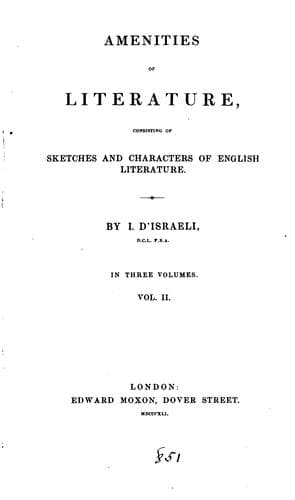
Amenities of Literature: Consisting of Sketches and Characters of English LiteratureDisraeli, Isaac
History
Amenities of Literature: Consisting of Sketches and Characters of English Literature
Disraeli, Isaac
Authors, English -- Biography; English literature -- History and criticism; Great Britain -- Intellectual life
He flew in the morning to the town-reeve to announce a wonder, that he
had become a poet in the course of a single night. He recited the poem,
which, however--for we possess it--only proves that between sleeping and
waking eighteen lines of dreamy periphrasis may express a single idea.
Venerable Bede held this effusion as a pure inspiration: the modern
historian of the Anglo-Saxons indulgently discovers three ideas:
Conybeare, more critical, acknowledges that "the eighteen lines expand
the mere proposition of 'Let us praise God, the maker of heaven and
earth.'" But this was only the first attempt of a great enterprise--it
was a thing to be magnified for the neighbouring monastery of Whitby,
who gladly received such a new brother.
For a poet who had never written a verse, it was only necessary to open
his vein: a poet who could not read only required to be read to. The
whole monkery came down with the canonical books; they informed him of
all things, from "Genesis" down to "the doctrine of the apostles." "The
good man listened," as saith Venerable Bede, "like a clean animal
ruminating; and his song and his verse were so winsome to hear, that his
teachers wrote them down, and learned from his mouth." These teachers
could not have learned more than they themselves had taught. We can only
draw out of a cistern the waters which we have poured into it. Every
succeeding day, however, swelled the Cædmonian Poem; assuredly they
wanted neither zeal nor hands--for the glory of the monastery of Whitby!
Such is a literary anecdote of the seventh century conveyed to us by
ancient Bede. The dream of the apparition's inspiration of this
unlettered monk was one more miracle among many in honour of the
monastery; and it was to be told in the customary way, for never yet in
a holy brotherhood was found a recusant.
Even to this day we ourselves dream grotesque adventures; but in the
days of monachism visions were not merely a mere vivid and lengthened
dream, a slight delirium, for they usually announced something
important. A dream was a prognostic or a prelude. The garrulous
chroniclers, and saintly Bede himself, that primeval gossiper, afford
abundant evidence of such secret revelations. Whenever some great act
was designed, or some awful secret was to be divulged, a dream announced
it to the world. Was a king to be converted to Christianity, the people
were enlightened by the vision which the sovereign revealed to them; was
a maiden to take the vow of virginity, or a monastery to be built, an
angelical vision hovered, and sometimes specified the very spot. Was a
crime of blood to be divulged by some penitent accessory, somebody had a
dream, and the criminal has stood convicted by the grave-side, which
gave up the fatal witness in his victim. In those ages of simplicity and
pious frauds, a dream was an admirable expedient by which important
events were carried on, and mystification satisfactorily explained the
incomprehensible.
Public-domain text, read in full here on John Shaqi.
Reviews
Reviews
No reviews yet
Be the first to share your thoughts on this work.
Join the Discussion
Join the discussion
Sign in to leave a comment or review.
Sign InorCreate an account