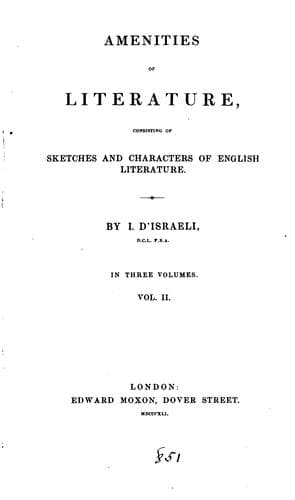
Amenities of Literature: Consisting of Sketches and Characters of English LiteratureDisraeli, Isaac
History
Amenities of Literature: Consisting of Sketches and Characters of English Literature
Disraeli, Isaac
Authors, English -- Biography; English literature -- History and criticism; Great Britain -- Intellectual life
[3] Among our ancestors all proper names were significant; and when
they are not, we have the strongest presumptive reasons for
suspecting that the name has been borrowed from some other tongue.
The piety of many monks in their pilgrimages in the Holy Land would
induce them to acquire some knowledge of the Hebrew or even the
Chaldee--Bede read Hebrew. A scholar who has justly observed this,
somewhat cabalistically has discovered that "the initial word of
Genesis in Chaldee," and printed in Hebraic characters [Hebrew:
behadsin], exhibits the presumed name of the Saxon monk.
[4] This sort of cento seems to have been a favourite fancy with this
masterly versifier; for of another Anglo-Saxon bard who composed on
warlike subjects, this critic says--"If the names of Patroclus and
Menelaus were substituted for Byrthnoth and Godric, some of the
scenes might be almost literally translated into a cento of lines
from Homer." Homer's claim to originality, however, is secure from
any critical collation with the old Saxon monk.
[5] Notwithstanding the information with which I was favoured, I
cannot divest myself of the notion that "the rebellion of the angels"
must be more explicitly described among the Jewish traditions than
yet appears; because we find allusions to it in two of the
apostolical writings. In the epistle of Jude, ver. 6: "_The angels
which kept not their first estate_, but left their own habitation, He
hath reserved in everlasting chains under darkness unto the judgment
of the great day." And in Peter, ii. 4: "_God spared not the angels
that sinned, but cast them down to Hell_, and delivered them unto
chains of darkness to be reserved unto judgment." These texts have
admitted of some dispute; but it seems, however, probable that the
apostles, just released from their Jewish bondage, had not
emancipated themselves from the received Hebraical doctrines.
[6] Paradise Lost, ii. 594.
[7] Inferno, Canto iii. 5.
[8] Cædmon, p. 29.
[9] Paradise Lost, i. 221.
[10] Paradise Lost, i. 592.
[11] Paradise Lost, v. 798.
[12] Guest's "History of English Rhythms," ii. 23.
Public-domain text, read in full here on John Shaqi.
Reviews
Reviews
No reviews yet
Be the first to share your thoughts on this work.
Join the Discussion
Join the discussion
Sign in to leave a comment or review.
Sign InorCreate an account