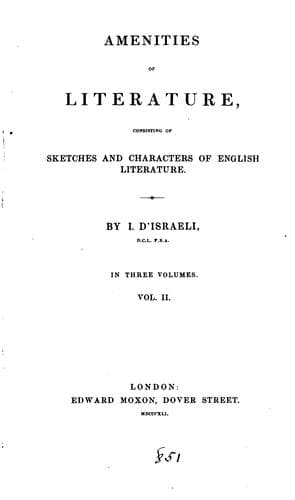
Amenities of Literature: Consisting of Sketches and Characters of English LiteratureDisraeli, Isaac
History
Amenities of Literature: Consisting of Sketches and Characters of English Literature
Disraeli, Isaac
Authors, English -- Biography; English literature -- History and criticism; Great Britain -- Intellectual life
enigmatical to the methodical investigations of the cold and cautious
TIRABOSCHI. That grave critic submitted the interior feeling of the poet
to the test of facts and dates. With more erudition than taste, he
marked the mechanical gradations--the stages of every language, from
rudeness to refinement. The mere historical investigator could conceive
no other style than what his chronology had furnished. But the spirit of
DANTE had penetrated beyond the palpable substances of the explorer of
facts, and the arranger of dates. DANTE, in his musings, had thrown a
mystical veil over the Italian language; but the poet presciently
contemplated, amid the distraction of so many dialects, that an Italian
style would arise which at some distant day would be deemed classical.
DANTE wrote, and DANTE was the classic of his country.
The third great master of the vernacular literature of Italy was
BOCCACCIO, who threw out the fertility of his genius in the _volgare_ of
nature herself. This Shakspeare of a hundred tales transformed himself
into all the conditions of society; he touched all the passions of human
beings, and penetrated into the thoughts of men ere he delineated their
manners. Even two learned Greeks acknowledged that the tale-teller of
Certaldo, in his variegated pages, had displayed such force and
diversity in his genius, that no Greek writer could be compared with his
"volgare eloquenza."
The Italian literature thus burst into birth and into maturity; while it
is remarkable of the other languages of Europe, that after their first
efforts they fell into decrepitude. Our Saxon rudeness seems to have
required more hewing and polishing to be modelled into elegance, and
more volubility to flow into harmony, than even the genius of its
earliest writers could afford. Dante, Petrarch, and Boccaccio were the
contemporaries of Gower, of Chaucer, and of "the Ploughman;" they
delight their nation after the lapse of many centuries; while the
critics of the reign of Elizabeth complained that Piers Ploughman,
Chaucer, and Gower then required glossaries; and so, at a later period,
did Ronsard, Baif, and Marot in France. In prose we had no single author
till the close of the sixteenth century who had yet constructed a style;
and in France Rabelais and Montaigne had contracted the rust and the
rudeness of antiquity, as it seemed to the refinement of the following
generation.
It cannot be thought that the genius of the Italians always excelled
that of other countries, but the material which those artists handled
yielded more kindly to their touch. The shell they struck gave a more
melodious sound than the rough and scrannel pipe cut from the northern
forests.
Public-domain text, read in full here on John Shaqi.
Reviews
Reviews
No reviews yet
Be the first to share your thoughts on this work.
Elsewhere in the archive
Join the Discussion
Join the discussion
Sign in to leave a comment or review.
Sign InorCreate an account