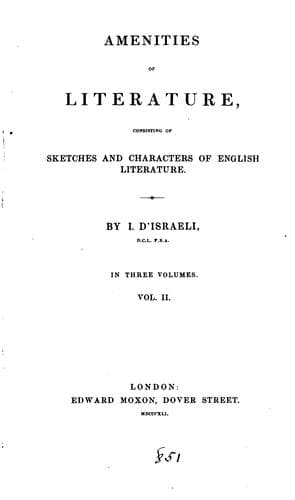
Amenities of Literature: Consisting of Sketches and Characters of English LiteratureDisraeli, Isaac
History
Amenities of Literature: Consisting of Sketches and Characters of English Literature
Disraeli, Isaac
Authors, English -- Biography; English literature -- History and criticism; Great Britain -- Intellectual life
Custom and prejudice, however, predominated over the feelings of the
learned even in Italy. Their epistolary correspondence was still carried
on in Latin, and their first dramas were in the language of ancient
Rome. ANGELO POLITIAN appears to have been the earliest who composed a
dramatic piece, his "Orfeo," in "stilo volgare," and for which he
assigns a reason which might have occurred to many of his
predecessors--"perchè degli spettatori fusse meglio intesa," that he
might be better understood by the audience!
The vernacular idiom in Italy was still so little in repute, while the
prejudice in favour of the Latin was so firmly rooted, that their youths
were prohibited from reading Italian books. A curious anecdote of the
times which its author has sent down to us, however, shows that their
native productions operated with a secret charm on their sympathies; for
VARCHI has told the singular circumstance that his father once sent him
to prison, where he was kept on bread and water, as a penance for his
inveterate passion for reading works in the vernacular tongue.
The struggle for the establishment of a vernacular literature was
apparent about the same period in different countries of Europe; a
simultaneous movement to vindicate the honour and to display the merits
of their national idiom.
JOACHIM DE BELLAY, of an illustrious literary family, resided three
years with his relative the Cardinal at Rome; the glory of the great
vernacular authors of Italy inflamed his ardour; and in one of his poems
he developes the beauty of "composing in our native language," by the
deeper emotions it excites in our countrymen. Subsequently he published
his "Defense et Illustration de la Langue Françoise," in 1549, where
eloquently and learnedly he would persuade his nation to write in their
own language. FERREIRA, the Portuguese poet, about the same time, with
all the feelings of patriotism, resolved to give birth to a national
literature; exhorting his countrymen to cultivate their vernacular
idiom, which he purified and enriched. He has thus feelingly expressed
this glorious sentiment--
Eu desta gloria so' fico contente
Que a minha terra amei, e a minha gente.
In Scotland we find Sir DAVID LYNDSAY, in 1553, writing his great work
on "The Monarchie," in his vernacular idiom, although he thought it
necessary to apologise, by alleging the example of Moses, Aristotle,
Plato, Virgil, and Cicero, who had all composed their works in their own
language.
In our own country Lord BERNERS had anticipated this general movement.
In 1525, when he ventured on the toil of his voluminous and spirited
Froissart, he described it as "translated out of Frenshe into our
_maternal English tongue_;" an expression which indicates those filial
yearnings of literary patriotism which were now to give us a native
literature.
Public-domain text, read in full here on John Shaqi.
Reviews
Reviews
No reviews yet
Be the first to share your thoughts on this work.
Elsewhere in the archive
Join the Discussion
Join the discussion
Sign in to leave a comment or review.
Sign InorCreate an account