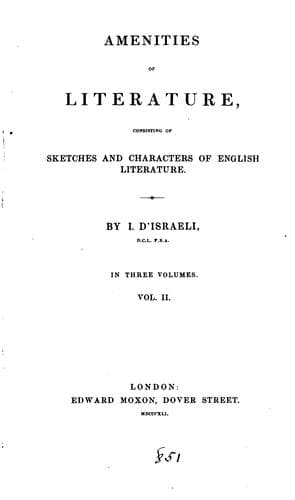
Amenities of Literature: Consisting of Sketches and Characters of English LiteratureDisraeli, Isaac
History
Amenities of Literature: Consisting of Sketches and Characters of English Literature
Disraeli, Isaac
Authors, English -- Biography; English literature -- History and criticism; Great Britain -- Intellectual life
The predominant prejudice of writing in Latin was first checked in
Germany, France, and England by the leaders of that great Revolution
which opposed the dynasty of the tiara. It was one of the great results
of the Reformation, that it taught the learned to address the people.
The versions of the Scriptures seemed to consecrate the vernacular idiom
of every nation in Europe. Peter Waldo began to use the vernacular
language in his version, however coarse, of the Bible for the Vaudois,
those earliest Reformers of the Church; and though the volume was
suppressed and prohibited, a modern French literary historian deduces
the taste for writing in the maternal tongue to this rude but great
attempt to attract the attention of the people. The same incident
occurred in our own annals; and it was the English Bible of Edward the
Sixth which opened the sealed treasures of our native language to the
multitude. Calvin wrote his great work. "The Institute of the Christian
Religion," at the same time in the Latin language and in the French; and
thus it happens that both these works are alike original. Calvin deemed
that to render the people intelligent their instructor should be
intelligible; and that if books are written for a great purpose, they
are only excellent in the degree that they are multiplied. Calvin
addressed not a few erudite recluses, but a whole nation.
It is unquestionable that the Reformation began to diminish the
veneration for the Latin language. Whether from the love of novelty, or
rather by that transition to a new system of human affairs, the pedantry
of ancient standing was giving way to the cultivation of a national
tongue. A great revolution was fast approaching, which would give a new
direction to the studies of the scholastic gentry, and introduce a new
mode of addressing the people. It was a revolution alarming those who
would have walled in public opinion by circumscribing all knowledge to a
privileged class. A remarkable evidence of this disposition appears in
an incident which occurred to Sir THOMAS WILSON, the author of two
English treatises on the arts of Logic and of Rhetoric. An emigrant in
the days of the Papistic Mary, he was arraigned at Rome before the
Inquisition, on the general charge of heresy, but especially for having
written his "Arts of Logic" and "of Rhetoric" in a language which, at
least we may presume, the whole conclave could not have criticised. The
torture was not only shown to him, but he tells us that "he had felt
some smart of it." The dark inquisitors taught our critic a new canon in
his own favourite arts; and our English Aristarchus soon discovered how
far those perfidious arts of reasoning and of eloquence may betray the
hapless orator, when his words are listened to by malicious judges,
equally skilled in mutilating sentences, or catching at loose words.
"They brought down my great heart by telling me plainly that my
_defence_ had put me into further peril." Our baffled rhetorician saw
Public-domain text, read in full here on John Shaqi.
Reviews
Reviews
No reviews yet
Be the first to share your thoughts on this work.
Elsewhere in the archive
Join the Discussion
Join the discussion
Sign in to leave a comment or review.
Sign InorCreate an account