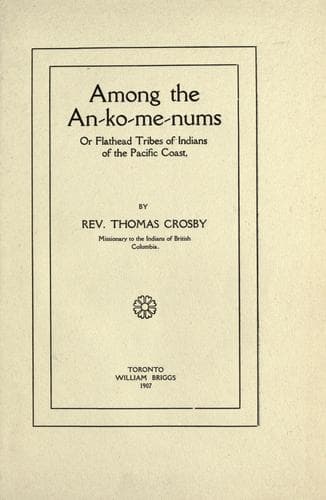
Among the An-ko-me-nums, or Flathead Tribes of Indians of the Pacific CoastCrosby, Thomas
History
Among the An-ko-me-nums, or Flathead Tribes of Indians of the Pacific Coast
Crosby, Thomas
Indians of North America -- Missions; Salish Indians
From here the stern-wheel steamers carried freight and passengers to
Yale, then the terminus of steamboat navigation, nearly one hundred
miles up the Fraser. Thence the miner carried his goods on his back, or
had them carried on the backs of pack animals or in ox-waggons, nearly
four hundred miles farther. About this time the great waggon road was
completed to Cariboo, and the treacherous trails over “Jackass” (a
difficult ascent behind Yale) and other mountains were abandoned.
In addition to the river route, hundreds of men came in overland from
California, by way of Whatcom and Sumas, or by the Columbia and through
the Okanagan Valley.
The winter of 1861-2 was one of unusual length and severity, and the
great “rush” to the mines set in too early, with the result that many
endured untold hardships and suffering, and many others who came into
the country were never heard of again.
Long before the summer was over hundreds returned--some from the mines
and some, indeed, who had never reached the mines--poorer and wiser
than when they came. Many who were cursing the country and leaving it
were advised to take up land and settle in the lovely valleys on the
Lower Fraser--Chilliwack, Sumas, and Langley, or the Delta lands near
the mouth. They derided the idea of these lands being any good. But
the few who did remain and take up land are now prosperous and wealthy
farmers, and have lived to see this once despised district become the
“Garden of British Columbia.”
The government of the country was then colonial, under a Governor
appointed by the Home Government and a small Council. James (afterwards
Sir James) Douglas, the first Governor, had been a Chief Factor in the
Hudson’s Bay Company and Governor of Vancouver Island. He was much
respected and beloved by all who knew him well, but especially by the
natives of the country. He was a wise, upright and impartial Governor
over the two colonies, Vancouver Island and British Columbia, which,
though nominally distinct, were for purposes of government practically
one.
About this time, when the rush to the mines produced a more or less
lawless condition of affairs, Matthew (afterwards Sir Matthew) Begbie,
an English barrister, was appointed to the bench. He dispensed justice
in the colonies with so firm a hand that for years he was a terror
to evil-doers. Many stories are told of him, but the following will
serve to show the fearless character of the man. A fellow was being
tried before him, charged with sand-bagging a miner and obtaining his
gold. There was hardly any doubt that he had committed the crime. The
evidence given was so convincing that a verdict of “guilty” appeared
the only possible one. But the jury found him not guilty. “Prisoner
at the bar,” said his lordship, “the jury have found you not guilty. I
discharge you, and now I recommend you to go and sand-bag the jurymen.”
Public-domain text, read in full here on John Shaqi.
Reviews
Reviews
No reviews yet
Be the first to share your thoughts on this work.
Join the Discussion
Join the discussion
Sign in to leave a comment or review.
Sign InorCreate an account