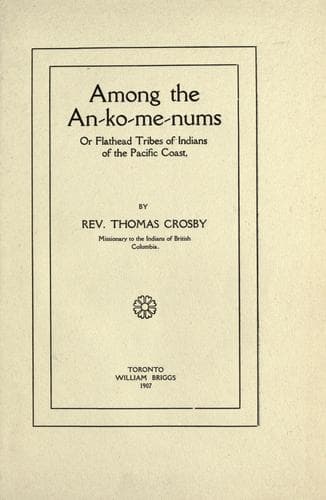
Among the An-ko-me-nums, or Flathead Tribes of Indians of the Pacific CoastCrosby, Thomas
History
Among the An-ko-me-nums, or Flathead Tribes of Indians of the Pacific Coast
Crosby, Thomas
Indians of North America -- Missions; Salish Indians
The excitement became great. One little boy was trying on a coat much
too big for him. Another little fellow got hold of a little pair of
pants which he thought were the thing for him, and was buttoning up the
waist, when the others burst into loud laughter and told him he had got
into them the wrong side first.
Some Indian women, directed by Mrs. Raybold, a good lady from town,
were soon busy with needle and thread, while the missionary plied the
shears. And so we worked and sewed and cut and fixed up, until we had
the children fairly well dressed.
The old people, in the meantime, showed very little appreciation,
often, indeed, taking the children away with the most silly excuses.
On their hunting and fishing trips they carried nearly all their
household effects, children, dogs, cats, chickens, etc. Hence we often
had to follow them and teach school on the beach, or under a shady tree
on the bank of the river.
After I had been some time at this work, spending my whole energy for
the benefit of their children, some of the parents asked me how long
they had to let their children go to school before I would pay them.
I replied, “Oh, I couldn’t pay you. In our country the people pay the
teacher.” “Oh, well,” they said, “we cannot let them go much longer
unless you pay us.”
But by and by the swing, our singing and kindness won the hearts of the
little ones, and they came of their own accord when the hand-bell was
rung.
Sometimes, on a fine day in the summer, they would take a notion to run
off and keep away from school. What boy or girl likes to attend school
on a hot day? When I started to round them up they made for the beach,
and when I drew near they would slip off their blanket or simple dress
and make a bolt for the salt water. In they would go, the tide being
up, diving and swimming away out of reach of everybody. For a little
you would lose sight of them, then away in the distance you would see
two or three little fellows pop up, shake their heads, rub their hands
over their faces, and cry out, “Ha! ha! ha!”
In spite of all the difficulties in the way of rapid progress, many who
were naturally bright made considerable advancement. It was from this
school that little Satana (afterwards David Sallosalton) came to me
and gave himself up to God and the work of evangelizing his people.
It was while I was engaged in my work at Nanaimo that I had the
pleasure of a visit from Wm. Duncan, of the Church Missionary Society,
who had spent several years among the Tsimpseans at Metlakatlah, and
who afterwards was instrumental in founding the model missionary
community at that place. The pleasurable acquaintance thus made was
years afterwards renewed when I went north to undertake missionary work
among the people of the same nation. Wm. Duncan was one of the most
successful of missionaries, earnest, devoted, resourceful, a man the
influence of whose life and labors will always be felt among the people
for whom his life was given.
Public-domain text, read in full here on John Shaqi.
Reviews
Reviews
No reviews yet
Be the first to share your thoughts on this work.
Join the Discussion
Join the discussion
Sign in to leave a comment or review.
Sign InorCreate an account