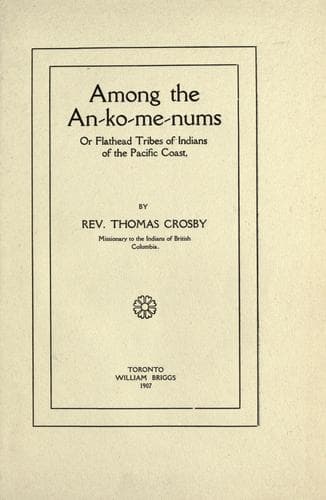
Among the An-ko-me-nums, or Flathead Tribes of Indians of the Pacific CoastCrosby, Thomas
History
Among the An-ko-me-nums, or Flathead Tribes of Indians of the Pacific Coast
Crosby, Thomas
Indians of North America -- Missions; Salish Indians
I took him to the magistrate, to whom he told his story and handed over
the bills. The official praised him for his honesty and faithfulness,
and as a reward gave him a note of recommendation saying what a good,
honest chief he was. This document, signed and sealed with a large red
seal and placed in an official envelope, pleased the chief very much.
Some weeks after he was in Victoria and happened to show this paper, of
which he was very proud, to a police officer, who at once put him in
jail, where he was held as a witness for over two months. During this
time his family were left to starve, and nothing was done to help them.
Is it any wonder that the Indians were enraged at this high-handed
piece of injustice, and that when the young chief finally was released
he declared that if all the Indians and whites in the place were
murdered he would never again tell anything that he had discovered
about the matter.
Speaking of the Indian’s love of “a big paper,” as they called an
official certificate, I recall the amusing circumstance of a chief who
was given “a paper” by a certain sea captain, which, not being able
to read, he supposed was highly complimentary. The Indian went about,
proudly showing to everyone a document which stated, “Look out for this
fellow; he is the greatest old rascal and biggest thief I have ever met
with.”
In those early days, when hundreds and thousands came from the north,
it was not an uncommon thing to see a body floating in the harbor. It
is the nature of an Indian always to keep in mind an old feud. Where
blood has been shed they seek retaliation, and with them it is always
“a life for a life.”
AN AWFUL NIGHT.
Tsil-ka-mut, a chief of the old school of the An-ko-me-nums, nephew of
Squin-es-ton, a chief of the Nanaimos, was the most influential man in
the tribe. Squin-es-ton was recognized as the head, but Tsil-ka-mut,
his nephew, led the way in all matters of business or council with
other tribes.
This younger chief in his youth was a great heathen, having been
trained up in all heathen secrets from a child. He would often go away
up the mountains and bathe in the mountain streams, where he said he
had communion with the spirits and received power.
He was a fine, stalwart, muscular fellow, with a foot very large and
almost as hard and tough as a horse’s hoof. He was a great hunter, and
could fight, too, when it came in his way, and would keep one by the
hour at his camp-fire telling of the bloody wars of former days. But he
used to say that he would rather live in peace at any time than amidst
war and trouble.
Tsil-ka-mut exerted a great and good influence over the people, and
his authority was respected. He seldom made speeches at their heathen
feasts or councils, but when he did speak they would, in the most
trying time, submit to what seemed to be his superior judgment.
Public-domain text, read in full here on John Shaqi.
Reviews
Reviews
No reviews yet
Be the first to share your thoughts on this work.
Join the Discussion
Join the discussion
Sign in to leave a comment or review.
Sign InorCreate an account