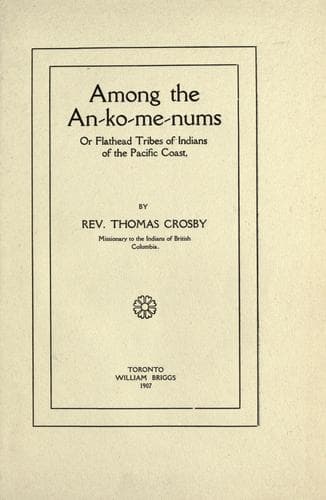
Among the An-ko-me-nums, or Flathead Tribes of Indians of the Pacific CoastCrosby, Thomas
History
Among the An-ko-me-nums, or Flathead Tribes of Indians of the Pacific Coast
Crosby, Thomas
Indians of North America -- Missions; Salish Indians
Under this roof, and immediately over the beds, were great sheets of
cedar bark or large rush mats, placed thus better to protect the beds
if the roof should leak, which it often did. There was no window, no
door, except a board propped up against the entrance; no chimney, the
smoke finding its way out through the cracks in the sides and roof; no
floor except the hard beaten earth.
These houses, which varied in size from buildings as large as a huge
barn to a small shack, were usually placed near the sea-shore or on
the bank of a river. The larger ones usually accommodated a number
of families, sometimes as many as eight or ten, and the building was
divided by low partitions into sections for each family.
Besides this type of house they constructed for winter use
an underground hut, usually spoken of as a “keekwillie
house”--“keekwillie” being Chinook for deep or underground. A deep pit
was dug in the ground and stout poles were placed leaning together like
a tepee, with a hole at the centre. The earth was heaped up around and
upon the top, very much as eastern farmers cover their potato pits. The
hole in the top was the only doorway, the only passageway for light,
and the only opening for the smoke to escape.
A notched pole was placed up the side of the roof and another protruded
from the interior through the opening in the top. By these two poles
the occupants passed in and out of this dwelling. You had to be
careful, if your clothing was made of any inflammable material, in
passing through the opening in the top, so close was it to the fire
built below.
In olden days whole villages lived in these keekwillie or sweat houses
during the winter, which were united by underground passages. In times
of war they were thus able to find shelter from an enemy by passing
from one to another.
In the summer camps the people lived under shelters made of large
rush-mats, open on one side. In front of this opening the camp-fire
was built. Of course, now many of them live in canvas tents or
“sail-houses,” as they call them, “sail” being the Chinook equivalent
for cloth of any kind. Many others of them live in small frame houses.
Speaking of the mats, these were very skilfully made by the women from
the large bulrushes which line the river banks. These were dried and
then woven together with a native twine made from the inner bark of the
cedar, or wild wiry grass. These mats were a very useful commodity,
for besides being used to form a shelter, they were sometimes laid in
several thicknesses and made a very comfortable bed.
TOOLS.
Public-domain text, read in full here on John Shaqi.
Reviews
Reviews
No reviews yet
Be the first to share your thoughts on this work.
Join the Discussion
Join the discussion
Sign in to leave a comment or review.
Sign InorCreate an account