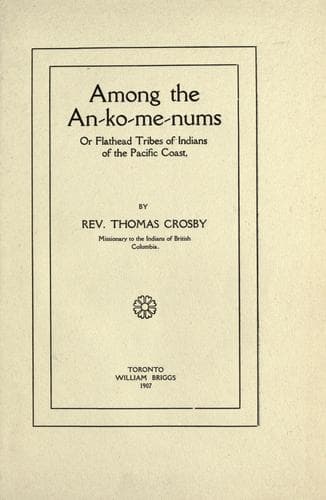
Among the An-ko-me-nums, or Flathead Tribes of Indians of the Pacific CoastCrosby, Thomas
History
Among the An-ko-me-nums, or Flathead Tribes of Indians of the Pacific Coast
Crosby, Thomas
Indians of North America -- Missions; Salish Indians
In olden times the An-ko-me-nums had tools for all purposes peculiar
to themselves. The Stone Age came down to later times among this
people. Trees were felled and split and canoes were shaped by means of
axes which were made of stone, carved into shape and notched. Around
this notch was fastened a rawhide thong or cedar withe, attached to
a handle. To assist in splitting the cedar logs wedges of wood, horn
or bone were used. And in order to prevent the wooden wedge from
splitting, withes from cedar boughs were firmly tied around its top.
Planks from two to five feet wide were split out of large trees by
means of these stone hammers and wedges.
[Illustration]
Their boards were planed, as were their canoes, with chisels and adzes
made of jade, a beautiful dark green stone, of a nature similar to
flint, which was found in large boulders in the bed of the Fraser and
other rivers. Later these adzes were made from old files provided by
the trading companies.
Hammers made of stone and shaped something like a pestle, and stone
mortars for crushing berries and mixing food, were among their
implements.
They had paint pots of stone, pipes made of slate or wood, needles
of various sizes made of wood or bone, knives of slate and granite,
besides spear-points and arrow-heads of flint and quartz.
CLOTHING AND ORNAMENTS.
In early days, on some parts of the Coast, the clothing of the people
was made from cedar bark. This was prepared by taking the inner bark
of the great cedar, soaking it in fresh water until it was completely
soft, and then beating it on a plank with an instrument made of bone or
very hard wood having grooves and ridges. It was then separated, the
soft parts being parcelled out into threads or skeins. These were laid
in the sun to bleach, or were dyed black or red, as suited their taste,
the natural color being pale yellow.
These threads were woven into rough cloth, which was made up for women
into a long, rough garment, without sleeves, tight around the neck and
tied sometimes with a string of the same material around the waist.
For men they made a cape with a hole in it for the head; it would come
down and protect the breast and shoulders. The same material was used
for towels or for packing the baby’s bed. The ordinary breech-clout was
made out of this cedar cloth.
Later the hair of the dog and mountain goat’s wool were spun together
and woven into blankets on simple native looms. Some of these blankets
were very beautiful, with patterns all their own, representing, as in
the case of the northern tribes, the totems of the wearers. Of course,
in later years the common garment was the “Indian blanket,” sold by the
Hudson’s Bay Company.
Chiefs and people of high rank wore the skins of animals, some of
which were dressed and tanned by native methods. Some were clothed in
the most beautiful furs--the priceless sea-otter, the bear, and other
animals--and were thus recognized as great chiefs or great hunters.
Public-domain text, read in full here on John Shaqi.
Reviews
Reviews
No reviews yet
Be the first to share your thoughts on this work.
Join the Discussion
Join the discussion
Sign in to leave a comment or review.
Sign InorCreate an account