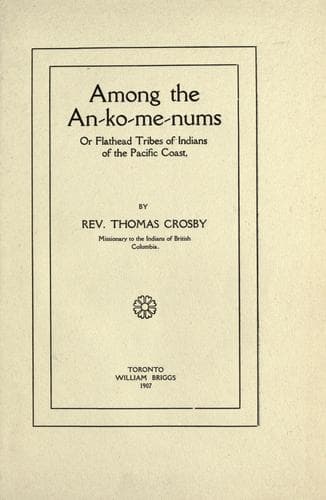
Among the An-ko-me-nums, or Flathead Tribes of Indians of the Pacific Coast — John Shaqi
Among the An-ko-me-nums, or Flathead Tribes of Indians of the Pacific CoastCrosby, Thomas
History
Among the An-ko-me-nums, or Flathead Tribes of Indians of the Pacific Coast
Crosby, Thomas
Indians of North America -- Missions; Salish Indians
These last inhabit the valley of the Fraser River, from Yale to
its mouth, and the east coast of Vancouver Island, from Comox to
Esquimault, and include the Nan-ni-moohs, Cowichans, Songees, Skwamish,
Sumats, Chil-way-uks, and numerous other rival tribes, possessed of the
same manners and customs, but speaking varying dialects of the same
language, and, in earlier days, engaging in the fiercest conflicts with
one another.
The Coast Indians are spoken of, generally, as Siwashes, a term which
the more intelligent resent, and which is taken from the word for
“Indian” in the Chinook or trade jargon.
There is some doubt, however, as to the origin of the word “Siwash.”
By some it is thought to be a corruption of the French word “Sauvage”
(barbarian), as applied by the Nor’westers to the Indians generally.
But in all probability it is a corruption of the generic term “Salish,”
which is given by ethnologists to the whole family, and as such is
improperly applied to the Northern tribes.
THE INDIANS OF BRITISH COLUMBIA.
There are some six distinct races among the Indians of British
Columbia. The Hydah-Kling-get, on Queen Charlotte Islands and the lower
Alaskan coast; the Tsimpshean, in the region of the lower Skeena and
Naas River; the Kwa-kualth, from Kitamaat to Cape Mudge on the mainland
and north-east coast of Vancouver Island; the Salish, of which the
An-ko-me-nums are a division, in the south; the Kootenai and the Déné
or Tinne, in the interior. The At nation, which occupies the west coast
of Vancouver Island, it would appear, is still another race, though
some ethnologists identify them with the Kwa-kualths.
The origin of these various people is much in doubt. The Tinne possibly
came by way of the Aleutian Islands from Asia. The Northern Coast
tribes, Hydahs and Tsimpsheans, may be related to the Filipinos and
the Japanese. Some years ago, when the first Japanese fishermen came
to the Skeena, the Indians immediately claimed them as their “tilikum”
(friends). When the difference in language was pointed out, they
replied, “That does not matter, the Indians speak different languages.
Just look at their hair and their eyes and the color of their skin, is
it not the same as ours? They are surely of our race.” The resemblance
so noted is certainly remarkable.
As for the Salish and Kwa-kualths, the similarity between certain of
their words and those of the Polynesian Islanders has led some to give
them an Oceanic origin.
The various sources from which they possibly sprang will sufficiently
explain the difference in their languages.
EARLY TRADERS.
Very early in the last century the trading ships of various nations
were visiting the coast and bartering their cargoes of firearms, rum
and useless trinkets--beads, bits of iron and brass--for the valuable
furs of the natives.
Public-domain text, read in full here on John Shaqi.
Reviews
Reviews
No reviews yet
Be the first to share your thoughts on this work.
Join the Discussion
Join the discussion
Sign in to leave a comment or review.
Sign InorCreate an account