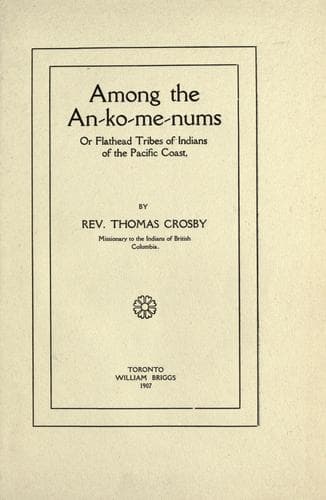
Among the An-ko-me-nums, or Flathead Tribes of Indians of the Pacific CoastCrosby, Thomas
History
Among the An-ko-me-nums, or Flathead Tribes of Indians of the Pacific Coast
Crosby, Thomas
Indians of North America -- Missions; Salish Indians
All were fond of ornaments, such as ear-rings, necklaces, bracelets,
finger rings, ankle bangles and nose jewels. Some wore large rings in
their noses, while slaves often had a long stick through the hole
in their noses. There was also the remarkable lip button or labret,
worn by perforating the lower lips of the females, which insertion was
enlarged with increasing age, from one to three and a half inches long
and from one-quarter to one and a half inches wide. These latter were
only worn by people of high rank.
Long shells like goose quills, called toothpick shells, about three
inches long, taken from the salt water, were much used as ornaments.
They were strung together and sold by the fathom, five fathoms being
reckoned the price of a slave.
The men of nearly all the Coast tribes had the lobe of the ear
perforated, this being done in early childhood, and frequently in olden
times you would see them with large rings or large pieces of abalone
shell hanging to their noses.
Ear-rings were worn in a series of perforations in the lobe of the ear.
We have seen them with three and four smaller pieces of abalone shell
at the upper part of the ear, or a very large one at the lower part
of the ear. At a more recent date these were replaced by ear-rings of
silver and gold of various designs, like their white friends.
PAINTING AND TATTOOING.
Tattooings were sometimes observed on their wrists and arms and
breasts, but the custom was not so general as with the northern tribes.
They, however, in common with other Indian peoples, were accustomed
to the use of paints in decorating the body. They had their own native
paints, some made from ground stone, others from a certain kind of
clay. They had also very strong dyes from sundry kinds of roots and
bark; also an oily substance from salmon roe, as well as several kinds
of gum from trees.
In dressing they painted the eyebrows black, like a half moon, the face
sometimes checked in small red squares, arms and legs and part of the
body red. Sometimes but half the face was painted red in squares, and
sometimes black. At other times the whole face was as black as tar.
Some also covered the face with a quantity of bear’s grease, almost
an eighth of an inch thick, or laid it on in ridges like beads in a
joiner’s work and then painted the ridge red.
They often told us that on a hot day this was to keep the sun from
burning the face, and in the winter they claimed it kept the cold,
sharp wind from cutting or chapping the skin.
Chiefs and people of rank used a kind of mineral or black shining
powder, glistening in the sun like silver, taken from the rocks.
The picture of a fierce warrior, almost nude, painted up with these
striking colors, and brandishing a knife, stone axe or war-club, and in
later years armed with a flint-lock musket, was enough to terrify the
beholder.
Public-domain text, read in full here on John Shaqi.
Reviews
Reviews
No reviews yet
Be the first to share your thoughts on this work.
Join the Discussion
Join the discussion
Sign in to leave a comment or review.
Sign InorCreate an account