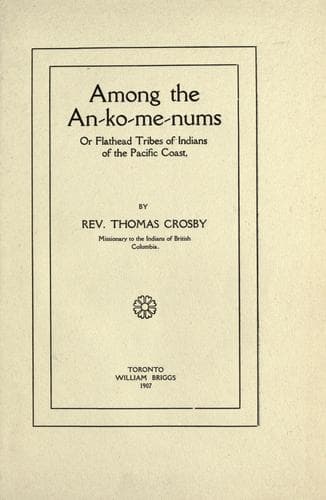
Among the An-ko-me-nums, or Flathead Tribes of Indians of the Pacific CoastCrosby, Thomas
History
Among the An-ko-me-nums, or Flathead Tribes of Indians of the Pacific Coast
Crosby, Thomas
Indians of North America -- Missions; Salish Indians
CHAPTER X. _COURTSHIP AND MARRIAGE._
“Thus it is our daughters leave us,
Those we love, and those who love us!
Just when they have learned to help us,
When we are old and lean upon them,
Comes a youth with flaunting feathers,
With his flute of reeds, a stranger
Wanders piping through the village,
Beckons to the fairest maiden,
And she follows where he leads her,
Leaving all things for the stranger!”
--_Longfellow’s “Hiawatha.”_
An An-ko-me-num courtship, and the marriage which followed, differed
entirely from that with which we are most familiar. One heathen
wedding, which I witnessed early in my stay at Nanaimo, very perfectly
illustrates the difference between their customs and ours.
Chief Tsil-ka-mut lived in a large old heathen house about 150 feet
long by 40 feet wide. Tsil-la-meah, his eldest daughter, by his eldest
wife--for he had two wives--was a modest Indian maiden, who had been
strictly kept, as a chief’s daughter, according to heathen law.
On one occasion, when one of H. M. ships of war was anchored in the
harbor, a number of bluejackets were allowed out on leave. They filled
up with liquor in the town, and then marched down through the woods,
over a mile, to the Indian village, cutting clubs as they went. When
they reached the village they shouted and swore and acted like demons,
and began to drive the people out of their houses and insult their
young women.
Among them were two professedly petty officers, who made their way into
Tsil-ka-mut’s big house, where his daughter, Tsil-la-meah, was busy
with her needle, while her mother sat near her on the floor working
at a mat. These rough men sat down, one on each side of the innocent
maid, and began to push her. The child, for she was little more than
that at the time, became afraid of them, and the anxious mother cried,
“Klata-wah! klata-wah!” (“Go away! go away!”). They paid no attention
and still persisted in their insults, until finally the mother, in her
own language, called out for the chief, who was at the other end of the
long house, taking a meal with some of his clan. Leaping over the floor
Tsil-ka-mut dashed around the corner of the partition which enclosed
his family room, and in a trice was facing these ruffians. Immediately
he shouted, pointing to the door, “Klata-wah! klata-wah!” which in this
tone of voice meant “Get out, and hurry about it.”
“Oh, no! oh, no!” said the poor fools, grinning like gaping idiots as
they spoke.
With that he seized a paddle and smashed it over their heads, repeating
in a towering voice, “Klata-wah! klata-wah!”
Then these big fellows, who had been sent out with others from the Home
Land to help keep peace among the Indians, scampered out of the house
and away without further ceremony.
Public-domain text, read in full here on John Shaqi.
Reviews
Reviews
No reviews yet
Be the first to share your thoughts on this work.
Join the Discussion
Join the discussion
Sign in to leave a comment or review.
Sign InorCreate an account