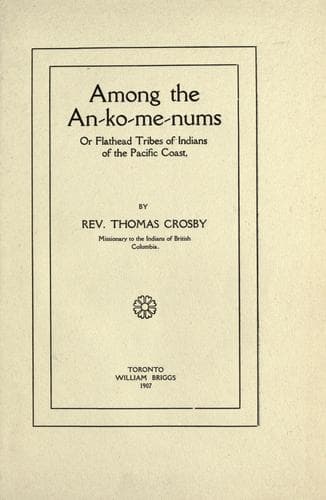
Among the An-ko-me-nums, or Flathead Tribes of Indians of the Pacific CoastCrosby, Thomas
History
Among the An-ko-me-nums, or Flathead Tribes of Indians of the Pacific Coast
Crosby, Thomas
Indians of North America -- Missions; Salish Indians
It was well that a paddle was the only weapon to hand. For had
Tsil-ka-mut used his old musket, or something heavier, they might
have paid the penalty with their lives. And then the cry would have
gone forth, “Those desperate, savage Indians, they should all of them
be shot.” Unfortunately, many of them have been shot for more paltry
reasons than that.
It is of the courtship and marriage of this same Tsil-la-meah, at that
time a pupil in our school, that I now propose to write.
A young chief who lived some distance to the south made his way
overland to her village, and began what seemed to be an old-fashioned
heathen courtship. No one knew of his arrival till he was found one
morning in the great long house, sitting by a post on the cold earthen
floor with a blanket around him.
On my rounds to gather up the children for school I noticed this
stranger, a slender young man, sitting there, looking very lonely.
I asked who he was, and they told me he was a young prince from
Qua-mit-son, some fifty miles away, and that he had come to see if he
would be accepted as a suitor for Chief Tsil-ka-mut’s daughter. He had
to remain there three days and three nights, according to custom, and
if during that time he was invited to partake of food with the family
of the young princess his way was all clear; if not, he could go about
his business.
However, during the last day he was invited to eat with the family. We
do not know that he had anything to say to the young maiden regarding
the state of his affections, or whether he ever saw her during his stay
there, but as soon as he had proved himself welcome to the family he
was off overland to his home.
Some months after this we heard that a whole tribe of people were to
arrive early one morning from the south, and that Chief Tsil-ka-mut’s
daughter was going to be married to the young chief who had been there
courting. The whole village was in excitement, when presently some
thirty canoes were sighted rounding a point about two miles away, and
a great cracking of musketry announced the coming of the strangers. On
they came, beating their drums and singing the marriage song as they
drew near the village.
In the lead came a band of the principal chiefs, old warriors and
musicians, gorgeously painted and feathered up, standing upon a
platform which was built on top of two large canoes lashed together. In
their midst was the young man himself, well dressed in European style.
The singing continued till they got to the beach. By this time the
crowd of villagers were all thronged around the canoes. The young man
and the painted warriors stepped out and quietly walked to the chief’s
house, all the rest following. The villagers busied themselves packing
up the visitors’ goods and hauling their canoes high up on the beach.
The day was then spent in resting and feasting.
Public-domain text, read in full here on John Shaqi.
Reviews
Reviews
No reviews yet
Be the first to share your thoughts on this work.
Join the Discussion
Join the discussion
Sign in to leave a comment or review.
Sign InorCreate an account