Produced by Feòrag NicBhrìde, Ron Stephens, David Garcia
and the Online Distributed Proofreading Team at
http://www.pgdp.net (This file was produced from images
generously made available by The Internet Archive/American
Libraries.)
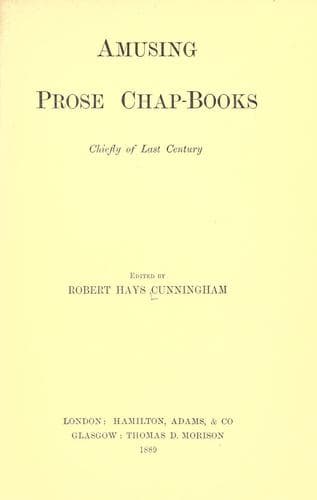
AMUSING
PROSE CHAP-BOOKS
_Chiefly of Last Century_
EDITED BY
ROBERT HAYS CUNNINGHAM
LONDON: HAMILTON, ADAMS, & CO
GLASGOW: THOMAS D. MORISON
1889
EDITORIAL NOTE.
Of late years there has been a largely increasing interest on the
subject of folklore in its various departments. In such respects there
has been a very considerable change in the feelings and tastes of the
educated middle-class population of this country, from what there was
several generations ago. Formerly the educated classes appeared to think
that anything relating to the tastes or ideas of the common people was
of very little interest. And in the course of some two hundred years
back, leaving out the present time, the number of writers who thought it
worth their while to deal with such topics were not much more than a
dozen in number, including such men as Aubrey, Bourne, Brand, Hone,
Strut, Halliwell, etc. Now, all that is changed, and it has been
discovered that much of extreme interest can be learned from the
superstitions, habits, beliefs, tastes, customs, ideas, amusements, and
general social life of the uneducated or lower classes of previous
times.
Not the least interesting or least important of the many sources from
which information on these and similar matters, can be obtained, is that
of the _people's_ earliest popular literature--namely, the chap-book.
Beginning at little after the commencement of the eighteenth century,
and continuing for over a hundred years afterwards, right up to the
general introduction and use of cheap magazines and cheap newspapers,
the chap-book was almost the only kind of reading within the reach of
the poorer portion of the nation.
What adds greatly both to the interest attaching to the chap-book
literature and to its importance, is the fact, that these literary
productions, if they may be so termed, were almost entirely written by
the people themselves; that is, they were written by the people for the
people. This fact intensifies the conviction that they give a true and
unvarnished description of the lower orders and their ways. Then, as
now, every district had its proportion of local geniuses, who had a gift
above their fellows in the matter of storytelling, or some other such
way. And in many instances these narratives became chap-books, and were
printed and reprinted times without number at the various printing
establishments over the country devoted to business of that description.
Public-domain text, read in full here on John Shaqi.
Reviews
Reviews
No reviews yet
Be the first to share your thoughts on this work.
Join the Discussion
Join the discussion
Sign in to leave a comment or review.
Sign InorCreate an account