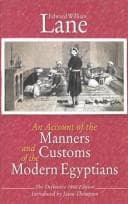
An account of the manners and customs of the modern EgyptiansLane, Edward William
History
An account of the manners and customs of the modern Egyptians
Lane, Edward William
Egypt -- Social life and customs
results is generally made to ascend upon the supposed sufferer.
It is a custom among the higher and middle classes in Cairo, on the
occasion of a marriage, to hang chandeliers in the street before the
bridegroom’s house; and it often happens that a crowd is collected to
see a very large and handsome chandelier suspended: in this case it is a
common practice to divert the attention of the spectators by throwing
down and breaking a large jar, or by some other artifice, lest an
envious eye should cause the chandelier to fall. Accidents which confirm
the Egyptians in their superstitions respecting the evil eye often
occur: for instance, a friend of mine has just related to me that, a
short time ago, he saw a camel carrying two very large jars of oil; a
woman stopped before it, and exclaimed, “God preserve us! What large
jars!” The conductor of the camel did not tell her to bless the Prophet;
and the camel, a few minutes after, fell, and broke both the jars and
one of its own legs.
While writing these notes on modern Egyptian superstitions, I have been
amused by a complaint of one of my Masree[382] friends, which will serve
to illustrate what I have just stated. “The Básha,” he said, “having, a
few days ago, given up his monopoly of the meat, the butchers now
slaughter for their own shops; and it is quite shocking to see fine
sheep hung up in the streets, quite whole, tail[383] and all, before the
public eye, so that every beggar who passes by envies them; and one
might, therefore, as well eat poison as such meat.” My cook has made the
same complaint to me; and, rather than purchase from one of the shops
near at hand, takes the trouble of going to one in a distant quarter,
kept by a man who conceals his meat from the view of the passengers in
the street.
Many of the tradesmen of the metropolis, and of other towns of Egypt,
place over their shops (generally upon the hanging shutter which is
turned up in front) a paper inscribed with the name of God, or that of
the Prophet, or both, or the profession of the faith (“There is no deity
but God: Mohammad is God’s Apostle”), the words, “In the name of God,
the Compassionate, the Merciful,” or some maxim of the Prophet, or a
verse of the Kur-án (as, “Verily we have granted thee a manifest
victory” [ch. xlviii., ver. 1], and “Assistance from God, and a speedy
victory: and do thou bear good tidings to the believers” [ch. lxi., ver.
13]), or an invocation to the Deity, such as, “O Thou Opener [of the
doors of prosperity, or subsistence]! O Thou Wise! O Thou Supplier of
our wants! O Thou Bountiful!” This invocation is often pronounced by the
tradesman when he first opens his shop in the morning, and by the
pedestrian vendor of small commodities, bread, vegetables, etc., when he
sets out on his daily rounds. It is a custom also among the lower orders
to put the first piece of money that they receive in the day to the lips
and forehead before putting it in the pocket.
Public-domain text, read in full here on John Shaqi.
Reviews
Reviews
No reviews yet
Be the first to share your thoughts on this work.
Elsewhere in the archive
Join the Discussion
Join the discussion
Sign in to leave a comment or review.
Sign InorCreate an account