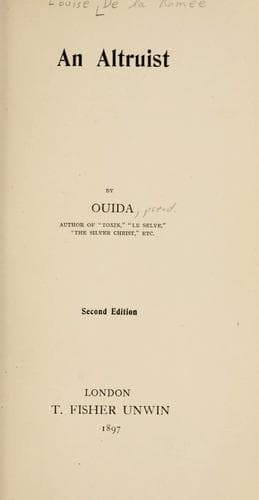
Laundresses -- Fiction; London (England) -- Fiction; Man-woman relationships -- Fiction; Rich people -- Fiction
“That shows you don’t understand your public, or don’t want to secure
one. Extreme opinions, my dear boy, can only be got down the throats
of the world in a weekly journal by being adroitly sandwiched between
the caviare of calumny and the butter of fashion. People hate to be
made to think, my dear boy. The _Age to Come_ gives ’em nothing but
thinking; and damned tough thinking too. You write with uncommon power,
but you are too wholesale, too subversive; you scare people so awfully
that they stop their ears to your truths. That is not the way to secure
a hearing.”
“I am consistent.”
“Oh, Lord! Never be consistent. There’s nothing so unpopular in life.”
“I despise popularity.”
“You despise bread and butter. I believe you lose twenty pound a month
by your _Age to Come_?”
“To speak more correctly,” replies Bertram, bitterly, “it gets me into
debt to that amount!”
“Heaven and earth! Why don’t you drop it?”
“It is a matter of principle.”
“Principle which will land you in Queer Street. Now, my dear Wilfrid,
no man thinks more things bosh than I do, or takes more pleasure in
saying so, but I combine pleasure with business; I say my say in such a
way that it brings me in eighty per cent.”
Bertram looks at him derisively.
“I have always known that your intellect was only equalled by your
venality!”
Fanshawe laughs good-humouredly.
“That is neat. That is soothing. It is not difficult to understand
that you are not considered a clubbable man! However, as you credit me
with intellect, I don’t mind your denying me morality. But seriously,
my dear friend, you are much too violent, too uncompromising for
success in journalism. Who tries to prove too much fails to prove
anything, and when you bend your bow too violently it snaps and speeds
no arrow. I confess that I (who am as revolutionary as most people
and always disposed to agree with you) do frequently get up from the
perusal of one of your articles with the unwilling conviction that it
is best to let the old order of things alone. Now, that is certainly
not the condition of mind which you wish to produce in your readers.”
Bertram is silent. After a pause he says:
“What do you advocate, then? A cautious trimming?”
“Trimming was the name which the eighteenth-century politician gave to
what we now call opportunism. All sagacious men are not opportunists,
but all sagacious men endeavour to create supporters, not antagonists.
Now, all violent assertion raises opposition, for human nature is
cantankerous and contradictory.”
Critchett enters and hands a card on a salver. “If you please, sir,
the gentleman’s waiting below; says he sent you a letter two days ago;
gentleman’s head of the firm of Folliott and Hake, sir.”
Bertram looks vaguely about the room. “There are a good many letters
unopened. I wonder which it is?”
Fanshawe catches up a pile of letters from a writing-table and sorts
them: “Here’s one with ‘Folliott and Hake’ on the seal; how unpractical
you are, dear boy!”
Public-domain text, read in full here on John Shaqi.
Reviews
Reviews
No reviews yet
Be the first to share your thoughts on this work.
Join the Discussion
Join the discussion
Sign in to leave a comment or review.
Sign InorCreate an account