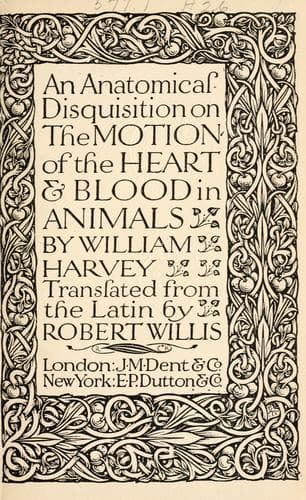
An anatomical disquisition on the motion of the heart & blood in animalsHarvey, William
Science
An anatomical disquisition on the motion of the heart & blood in animals
Harvey, William
Blood -- Circulation
1st. With reference to the colour it is to be observed, that wherever
the blood issues by a very small orifice, it is in some measure
strained, and the thinner and lighter part, which usually swims on
the top and is the most penetrating, is emitted. Thus, in phlebotomy,
when the blood escapes forcibly and to a distance, in a full stream,
and from a large orifice, it is thicker, has more body, and a darker
body; but, if it flows from a small orifice, and only drop by drop,
as it usually does when the bleeding fillet is untied, it is of a
brighter hue; for then it is strained as it were, and the thinner and
more penetrating portion only escapes; in the same way, in the bleeding
from the nose, in that which takes place from a leech-bite, or from
scarifications, or in any other way by diapedesis or transudation, the
blood is always seen to have a brighter cast, because the thickness
and firmness of the coats of the arteries render the outlet or outlets
smaller, and less disposed to yield a ready passage to the outpouring
blood; it happens also that when fat persons are let blood, the orifice
of the vein is apt to be compressed by the subcutaneous fat, by which
the blood is made to appear thinner, more florid, and in some sort
arterious. On the other hand, the blood that flows into a basin from a
large artery freely divided, will look venous. The blood in the lungs
is of a much more florid colour than it is in the arteries, and we know
how it is strained through the pulmonary tissue.
2d. The emptiness of the arteries in the dead body, which probably
misled Erasistratus in supposing that they only contained aereal
spirits, is caused by this, that when respiration ceases the lungs
collapse, and then the passages through them are closed; the heart,
however, continues for a time to contract upon the blood, whence we
find the left auricle more contracted, and the corresponding ventricle,
as well as the arteries at large, appearing empty, simply because there
is no supply of blood flowing round to fill them. In cases, however, in
which the heart has ceased to pulsate and the lungs to afford a passage
to the blood simultaneously, as in those who have died from drowning
or syncope, or who die suddenly, you will find the arteries, as well as
the veins, full of blood.
Public-domain text, read in full here on John Shaqi.
Reviews
Reviews
No reviews yet
Be the first to share your thoughts on this work.
Elsewhere in the archive
Join the Discussion
Join the discussion
Sign in to leave a comment or review.
Sign InorCreate an account