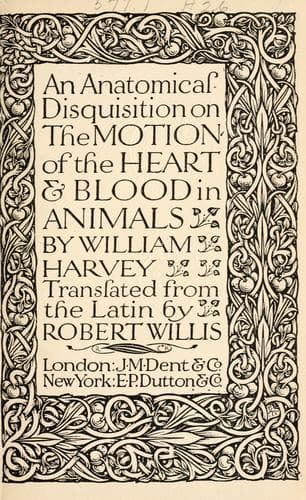
An anatomical disquisition on the motion of the heart & blood in animalsHarvey, William
Science
An anatomical disquisition on the motion of the heart & blood in animals
Harvey, William
Blood -- Circulation
3d. With reference to the third point, or that of the spirits, it may
be said that, as it is still a question what they are, how extant in
the body, of what consistency, whether separate and distinct from the
blood and solids, or mingled with these,--upon each and all of these
points there are so many and such conflicting opinions, that it is
not wonderful that the spirits, whose nature is thus left so wholly
ambiguous, should serve as the common subterfuge of ignorance. Persons
of limited information, when they are at a loss to assign a cause
for anything, very commonly reply that it is done by the spirits;
and so they bring the spirits into play upon all occasions; even as
indifferent poets are always thrusting the gods upon the stage as a
means of unravelling the plot, and bringing about the catastrophe.
Fernelius, and many others, suppose that there are aereal spirits and
invisible substances. Fernelius proves that there are animal spirits,
by saying that the cells in the brain are apparently unoccupied, and
as nature abhors a vacuum, he concludes that in the living body they
are filled with spirits, just as Erasistratus had held that, because
the arteries were empty of blood, therefore they must be filled with
spirits. But Medical Schools admit three kinds of spirits: the natural
spirits flowing through the veins, the vital spirits through the
arteries, and the animal spirits through the nerves; whence physicians
say, out of Galen, that sometimes the parts of the brain are oppressed
by sympathy, because the faculty with the essence, i.e. the spirit, is
overwhelmed; and sometimes this happens independently of the essence.
Farther, besides the three orders of influxive spirits adverted to, a
like number of implanted or stationary spirits seem to be acknowledged;
but we have found none of all these spirits by dissection, neither
in the veins, nerves, arteries, nor other parts of living animals.
Some speak of corporeal, others of incorporeal spirits; and they who
advocate the corporeal spirits will have the blood, or the thinner
portion of the blood, to be the bond of union with the soul, the spirit
being contained in the blood as the flame is in the smoke of a lamp or
candle, and held admixed by the incessant motion of the fluid; others,
again, distinguish between the spirits and the blood. They who advocate
incorporeal spirits have no ground of experience to stand upon;
their spirits indeed are synonymous with powers or faculties, such
as a concoctive spirit, a chylopoietic spirit, a procreative spirit,
&c.--they admit as many spirits, in short, as there are faculties or
organs.
Public-domain text, read in full here on John Shaqi.
Reviews
Reviews
No reviews yet
Be the first to share your thoughts on this work.
Elsewhere in the archive
Join the Discussion
Join the discussion
Sign in to leave a comment or review.
Sign InorCreate an account