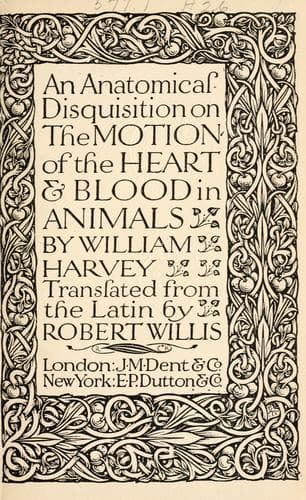
An anatomical disquisition on the motion of the heart & blood in animalsHarvey, William
Science
An anatomical disquisition on the motion of the heart & blood in animals
Harvey, William
Blood -- Circulation
But then the schoolmen speak of a spirit of fortitude, prudence,
patience, and the other virtues, and also of a most holy spirit of
wisdom, and of every divine gift; and they besides suppose that there
are good and evil spirits that roam about or possess the body, that
assist or cast obstacles in the way. They hold some diseases to be
owing to a Cacodæmon or evil spirit, as there are others that are due
to a cacochemy or defective assimilation.
Although there is nothing more uncertain and questionable, then, than
the doctrine of spirits that is proposed to us, nevertheless physicians
seem for the major part to conclude, with Hippocrates, that our body is
composed or made up of three elements, viz. containing parts, contained
parts, and causes of action, spirits being understood by the latter
term. But if spirits are to be taken as synonymous with causes of
activity, whatever has power in the living body and a faculty of action
must be included under the denomination. It would appear, therefore,
that all spirits were neither aereal substances, nor powers, nor
habits; and that all were not incorporeal.
But keeping in view the points that especially interest us, others,
as leading to tediousness, being left unnoticed, it seems that the
spirits which flow by the veins or the arteries are not distinct
from the blood, any more than the flame of a lamp is distinct from
the inflammable vapour that is on fire; in short, that the blood and
these spirits signify one and the same thing, though different,--like
generous wine and its spirit; for as wine, when it has lost all its
spirit, is no longer wine, but a vapid liquor or vinegar; so blood
without spirit is not blood, but something else--clot or cruor; even
as a hand of stone, or of a dead body, is no hand in the most complete
sense, neither is blood void of the vital principle proper blood; it
is immediately to be held as corrupt when deprived of its spirit. The
spirit therefore which inheres in the arteries, and especially in the
blood which fills them, is to be regarded either as its act or agent,
in the same way as the spirit of wine in wine, and the spirit of aqua
vitæ in brandy, or as a flame kindled in alcohol, which lives and feeds
on, or is nourished by itself. The blood consequently, though richly
imbued with spirits, does not swell, nor ferment, nor rise to a head
through them, so as to require and occupy a larger space,--a fact that
may be ascertained beyond the possibility of question by the two cups
of equal size; it is to be regarded as wine, possessed of a large
amount of spirits, or, in the Hippocratic sense, of signal powers of
acting and effecting.
Public-domain text, read in full here on John Shaqi.
Reviews
Reviews
No reviews yet
Be the first to share your thoughts on this work.
Elsewhere in the archive
Join the Discussion
Join the discussion
Sign in to leave a comment or review.
Sign InorCreate an account