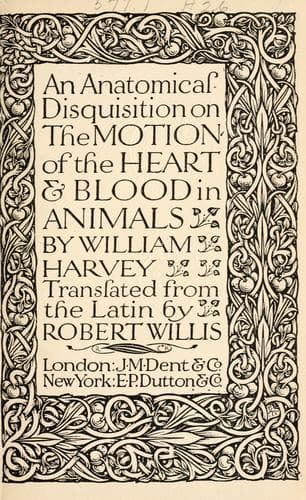
An anatomical disquisition on the motion of the heart & blood in animals — John Shaqi
An anatomical disquisition on the motion of the heart & blood in animalsHarvey, William
Science
An anatomical disquisition on the motion of the heart & blood in animals
Harvey, William
Blood -- Circulation
In two respects the work on Generation is worthy of more than a
mere passing notice, and entitles its author to the possession of
almost prophetic genius. The first is the enunciation of the great
generalisation _omne vivum ex ovo_. Although this particular phrase is
nowhere to be found, as is often erroneously stated, in the treatise on
Generation, yet a perusal of Exercises I., LI., and LXII. will convince
any one that Harvey had grasped this great idea, which has since been
so abundantly verified. The other is his doctrine of _Epigenesis_, or
the formation of the new organism from the homogeneous substance of the
germ by the successive differentiation of parts, that all parts are not
formed at once and together, but in succession one after the other. He
put forward this doctrine of Epigenesis in contradistinction to that of
_Metamorphosis_, according to which the germ was suddenly transformed
into a miniature of the whole organism which subsequently grew. This
is certainly very remarkable, and entitles him to be regarded as a
forerunner of Caspar Wolff, Von Baer, and the modern Evolutionary
School, which sees in the development of the organism from the ovum a
passage from the homogeneous to the heterogeneous by a gradual process
of differentiation, from a germ in which there is no sign of any of the
parts of the adult to an organism with all its many and varied organs.
Commenting on certain passages of Exercise XLV., in which Harvey
specially refers to this subject, the late Professor Huxley remarked:
“In these words, by the divination of genius, Harvey in the seventeenth
century summarised the outcome of the work of all those who, with
appliances he could not dream of, are continuing his labours in the
nineteenth century.”[17]
[17] Evolution: “Encyclopædia Britannica,” 9th ed. 1878.
In addition to his long sojourn in Italy as a student, Harvey made
several other visits to the Continent. In 1630 he consented to
accompany the young Duke of Lennox in his travels abroad. He had
returned by 1632, for in that year he was formally appointed physician
to Charles I. Again, in 1636 he accompanied the Earl of Arundel on his
embassy to the Emperor, and was absent some nine months. According to
Aubrey, in 1649 Harvey, with his friend Dr. George Ent, again visited
Italy. Some doubt has been thrown on this journey, but it receives
support from a letter of Harvey’s to John Nardi, of Florence, written
on November 30, 1653, in which he concludes by asking his correspondent
to mention his name to his Serene Highness the Duke of Tuscany, “with
thankfulness for the distinguished honour he did me when I was formerly
in Florence.”
Public-domain text, read in full here on John Shaqi.
Reviews
Reviews
No reviews yet
Be the first to share your thoughts on this work.
Join the Discussion
Join the discussion
Sign in to leave a comment or review.
Sign InorCreate an account