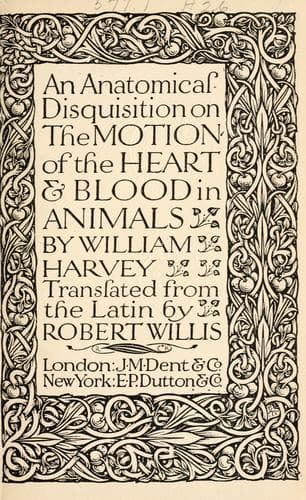
An anatomical disquisition on the motion of the heart & blood in animalsHarvey, William
Science
An anatomical disquisition on the motion of the heart & blood in animals
Harvey, William
Blood -- Circulation
In his old age Harvey was honoured in a striking manner by those
best fitted to judge of the merit and value of his life’s work. His
statue was erected in the hall of the College of Physicians. As an
acknowledgment, as it were, of this remarkable compliment, he built at
his own expense a Convocation Hall and a Library as additions to the
College, and contributed books, curiosities, and surgical instruments
for the Library and Museum. Not content with this, he made over to the
College, the year before he died, his paternal estate, stipulating
that a certain sum out of it should be employed every year for the
delivery of an Oration in commemoration of benefactors of the College,
and of those who had added anything to medical knowledge during the
year. This Oration is annually delivered by some distinguished member
of the medical profession, and is inseparably associated with the name
of Harvey. This graceful act shows how in his declining years Harvey’s
thoughts were turned to the future. It had for its object to further
the progress of scientific knowledge, to stimulate studies in the
pursuit of which he had shown himself such a master. He wished when old
and infirm, bereft of the power of again entering the arena of active
work and investigation, to still do something to increase and extend
that knowledge which is of so great service to mankind--a knowledge of
the human body in health and in disease.
Harvey died on June 3, in the year 1657, in the eightieth year of his
age, and was buried at the village of Hempstead, in Essex, in a vault
which had been built by his brother Eliab.
E. A. PARKYN.
LONDON, _November, 1906_.
The following is a list of Harvey’s works, and of the more important
references to his life and discovery:--
“MS. Memorandum Book,” dated 1616, entitled “Prælectiones Anatomicæ
Universalis.” It is in Harvey’s handwriting, and contains the
origin of the Circulation. (In the British Museum.) A Facsimile was
published in 1886 by the College of Physicians.
“MS. De Musculis,” 1627, in Harvey’s handwriting. (Brit.
Mus.) A Notice on this manuscript was published in 1850 by
G. E. Paget, M.D.
“MS. of Prescriptions,” 1647. (Brit. Mus.)
“MS. Diploma of Doctor of Medicine” to Harvey by University of Padua,
April 25, 1602. (In the College of Physicians.)
“MS. Illuminated Grant of M.D.,” by University of Padua to an
Englishman, Thomas Heron, which is witnessed by “Guigliomo Harveo
Consiliaris Magnificæ Nationis Anglæ.” It is dated March 19, 1602.
(Brit. Mus.)
“MS. Oratio Harveiana,” 1661, ab. E. Greaves. (Brit. Mus.)
“De Motu Cordis et Sanguinis,” Frankfort-on-Main, 1628. First English
edition published by R. Lowndes, with preface by Zachariah Wood,
Physician of Rotterdam, 1653.
“Anatomical Examination of the Body of Thomas Parr, aged 152 years,”
made in 1635, but not published until 1669 in Betts’ “De Ortu et
Natura Sanguinis.”
Public-domain text, read in full here on John Shaqi.
Reviews
Reviews
No reviews yet
Be the first to share your thoughts on this work.
Join the Discussion
Join the discussion
Sign in to leave a comment or review.
Sign InorCreate an account