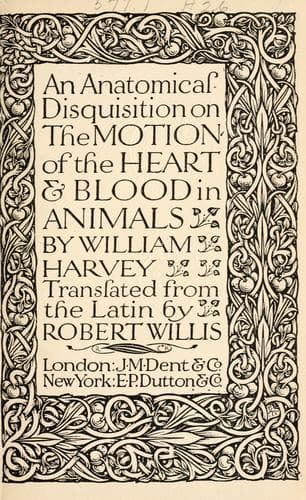
An anatomical disquisition on the motion of the heart & blood in animalsHarvey, William
Science
An anatomical disquisition on the motion of the heart & blood in animals
Harvey, William
Blood -- Circulation
In 1616, the year Shakespeare died, Harvey probably began in his
classes to teach that doctrine which has immortalised his name. He
began to show his pupils, and whoever else desired to be present,
from dissections of the human body and of animals, and by experiment
when necessary, the true office of the heart, the true course of the
movement of the blood in the body. This he continued to do for more
than ten years, listening patiently to objections, indeed inviting
criticisms so that the complete truth might be discovered free from
any falsities or misconceptions. At last, upon the earnest entreaties
of his most distinguished medical friends, he was persuaded to publish
his discovery to the world. These facts are of interest in throwing
some light on Harvey’s character. A discoverer who waits years before
publishing what he is firmly convinced in his own mind is a new idea,
not to say a great discovery, must be possessed of that calmness
of mind and abnegation of self which we associate with the true
philosopher. A discoverer who employs so long an interval to give
opportunity for criticism, and to deal with objections, must indeed be
wedded to truth.
This devotion to truth, however, had its reward, for it resulted in
one of the most remarkable scientific treatises ever written. When, in
1628, Harvey published at Frankfort-on-Main, his book on “The Movement
of the Heart and Blood,” he gave his reasons for believing the blood to
circulate, and explained the use of the heart in language so simple,
so clear, so exact, that now, nearly three hundred years afterwards,
the most accomplished physiologist can hardly improve on it. This
assuredly is a fact almost unique in the history of science.
Public-domain text, read in full here on John Shaqi.
Reviews
Reviews
No reviews yet
Be the first to share your thoughts on this work.
Join the Discussion
Join the discussion
Sign in to leave a comment or review.
Sign InorCreate an account