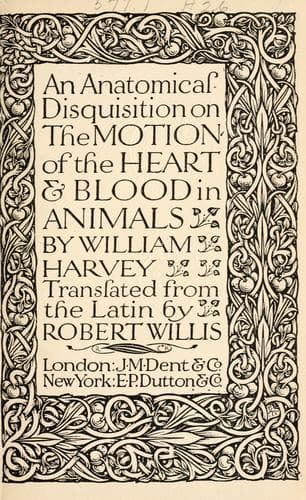
An anatomical disquisition on the motion of the heart & blood in animalsHarvey, William
Science
An anatomical disquisition on the motion of the heart & blood in animals
Harvey, William
Blood -- Circulation
And yet with all this the fact remains that Harvey never really knew,
from the nature of the case could not know, how the blood passed from
the arteries to the veins--how, in other words, an essential part
of the circulation was actually accomplished. The blood passes from
the arteries to the veins through minute microscopic tubes termed
capillaries. In Harvey’s day the microscope was not sufficiently
powerful to reveal such fine structures to human vision, and he was
therefore necessarily ignorant of their existence. Looked at from this
point of view, the discovery affords a very good example of what has
been aptly termed the scientific use of the imagination. Although, with
his imperfect microscope, it was impossible for him to know how the
blood actually passed from the arteries to the veins, yet as the result
of his observations and experiments he was able to infer and to state
the grounds for his inference in clear, forcible, and most convincing
language, that the blood must circulate, and circulate in one direction
only, viz. from the heart into the arteries, thence to the veins, by
which it was brought back to the heart again. His imagination was thus
enabled to bridge over the gulf between the arteries and veins which
his eyes, with the imperfect instrument then alone at his disposal,
were quite unable to cross. It was not until four years after Harvey’s
death that the microscope had been sufficiently improved to enable an
Italian anatomist named Malpighi,[10] in the year 1661, to actually
observe the capillaries uniting by their networks arteries and veins.
[10] De Pulmonibus, Observationes Anatomici, 1663.
The work was published at Frankfort doubtless that it might be more
easily disseminated over the Continent. It made a sensation among
the learned of all countries. Its conclusions were opposed by the
older physicians; but by the younger scientific men it was by no
means received with disfavour. Amongst the latter was the philosopher
Descartes, whose name was then a power in Europe. The philosophical,
yet keenly practical mind of Descartes grasped the discovery with
avidity and supported it with ardour. In his celebrated “Discours de la
Méthode,”[11] he refers to the discovery of “an English physician,” and
describes with enthusiasm the anatomy and use of the heart. Although
we have no certain information on the point it is quite possible that
Descartes may have known Harvey, for in the year 1631 he is said to
have paid a visit to England; and in his second reply to Riolan Harvey
refers to “the ingenious and acute Descartes,” and says the honourable
mention of his name demands his acknowledgments. Thus the discovery
became widely known and largely adopted.
[11] First published at Leyden in 4to, 1637.
Public-domain text, read in full here on John Shaqi.
Reviews
Reviews
No reviews yet
Be the first to share your thoughts on this work.
Join the Discussion
Join the discussion
Sign in to leave a comment or review.
Sign InorCreate an account