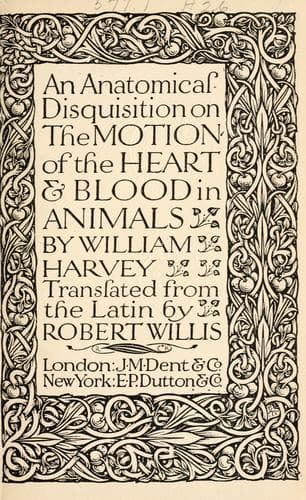
An anatomical disquisition on the motion of the heart & blood in animalsHarvey, William
Science
An anatomical disquisition on the motion of the heart & blood in animals
Harvey, William
Blood -- Circulation
ventricle in size and strength, and exactness of closing. Hence, too,
it is essential that there can be no heart without a ventricle, since
this must be the source and storehouse of the blood. The same law does
not hold good in reference to the brain. For almost no genus of birds
has a ventricle in the brain, as is obvious in the goose and swan, the
brains of which nearly equal that of a rabbit in size; now rabbits
have ventricles in the brain, whilst the goose has none. In like
manner, wherever the heart has a single ventricle, there is an auricle
appended, flaccid, membranous, hollow, filled with blood; and where
there are two ventricles, there are likewise two auricles. On the other
hand, however, some animals have an auricle without any ventricle;
or at all events they have a sac analogous to an auricle; or the vein
itself, dilated at a particular part, performs pulsations, as is seen
in hornets, bees, and other insects, which certain experiments of my
own enable me to demonstrate have not only a pulse, but a respiration
in that part which is called the tail, whence it is that this part is
elongated and contracted now more rarely, now more frequently, as the
creature appears to be blown and to require a larger quantity of air.
But of these things, more in our Treatise on Respiration.
It is in like manner evident that the auricles pulsate, contract, as
I have said before, and throw the blood into the ventricles; so that
wherever there is a ventricle an auricle is necessary, not merely
that it may serve, according to the general belief, as a source and
magazine for the blood: for what were the use of its pulsations had it
nothing to do save to contain? No; the auricles are prime movers of the
blood, especially the right auricle, which is “the first to live, the
last to die,” as already said; whence they are subservient to sending
the blood into the ventricle, which, contracting incontinently, more
readily and forcibly expels the blood already in motion; just as the
ball-player can strike the ball more forcibly and further if he takes
it on the rebound than if he simply threw it. Moreover, and contrary
to the general opinion, since neither the heart nor anything else can
dilate or distend itself so as to draw aught into its cavity during the
diastole, unless like a sponge, it has been first compressed, and as it
is returning to its primary condition; but in animals all local motion
proceeds from, and has its original in the contraction of some part: it
is consequently by the contraction of the auricles that the blood is
thrown into the ventricles, as I have already shown, and from thence,
by the contraction of the ventricles, it is propelled and distributed.
Which truth concerning local motions, and how the immediate moving
organ in every motion of an animal primarily endowed with a motive
spirit (as Aristotle has it,[34]) is contractile; and in what way the
word νευ̑ρον is derived from νεύω, nuto, contraho; and how Aristotle
Public-domain text, read in full here on John Shaqi.
Reviews
Reviews
No reviews yet
Be the first to share your thoughts on this work.
Elsewhere in the archive
Join the Discussion
Join the discussion
Sign in to leave a comment or review.
Sign InorCreate an account