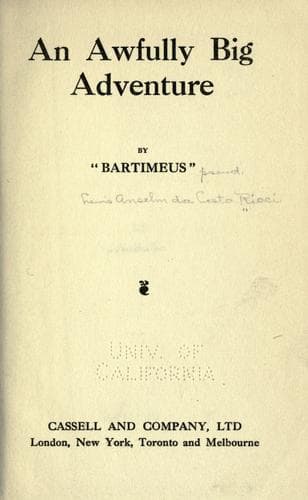
English fiction -- 20th century; Sea stories, English; War stories, English; World War, 1914-1918 -- Fiction
"Don't go, Emily. Don't shove off for a second. I only get wound up
like this once in a blue moon, and I'd better get it off my chest now
once and for all. Don't imagine I think these Miss Smedleys
represent women war-workers. I know they're a minority, but they
represent a type. I know something about the other sort--the ones
who've helped us to bash the Hun, and they make me feel like a
piffling slacker sometimes. How would you like to stand on your feet
for twelve hours a day doing acetylene gas welding, or ride eighty
miles carrying spare parts on a stink-bike through a snow
blizzard--not once, but as a daily routine? I was shipmates with a
bloke whose sister did that for two consecutive years. How would you
like swabbing out a gangrened wound in a part of a man's anatomy
polite civilisation makes him hide under clothes---? Don't raise
your eyebrows, Emily! The point I'm driving at is that thousands of
women do these things, and somehow manage to remain women----" He
mused reminiscently upon a then recent article in Blackwood's
Magazine--"Even when they pull off their petticoats and put on
breeches to plough an acre a day."
"I am sorry," said Lady Manners, on the threshold of the hall. "But
I quite fail to see the application of all this--this rant."
"It applies to Josephine Smedley and her kidney," replied the
seeker-after-ideal-womanhood. "It is my 'statement in mitigation.'
You, my dear Emily, having donned the black cap and condemned me to a
tea-party with the lady in question, cannot do less than listen to my
views." Graeme beamed at her irate ladyship, his ill-humour blown
away on the winds of vehemence. "And now here is Malcolm bowed down
with the affairs of the nation."
Sir Malcolm Manners, who wore a preoccupied air and carried a sheaf
of letters in his hand, entered as Graeme spoke. He was a meagre
individual with absent blue eyes and a drooping moustache tinted by
nicotine. His thin grey hair was parted unsymmetrically down the
centre, and one wisp, perpetually overlooked or rebellious against
restraint, stuck up from the crown like a cock's tail in miniature.
He stopped when he saw his wife and referred fussily to the letters
he carried, as if to refresh his mind from notes preparatory to
making a speech.
"We must go up to town for a few days, Emily. These fellows are
going to muddle everything without someone on the spot."
By "someone" he meant himself. The baronet was Chairman of a
Committee charged with the task of repatriating certain classes of
refugees. The refugees having no wish to be repatriated and the
Committee boasting not a single business man in its composition,
matters were not progressing as rapidly--so said the type-written
report in the Chairman's hands--as could be hoped.
Public-domain text, read in full here on John Shaqi.
Reviews
Reviews
No reviews yet
Be the first to share your thoughts on this work.
Join the Discussion
Join the discussion
Sign in to leave a comment or review.
Sign InorCreate an account