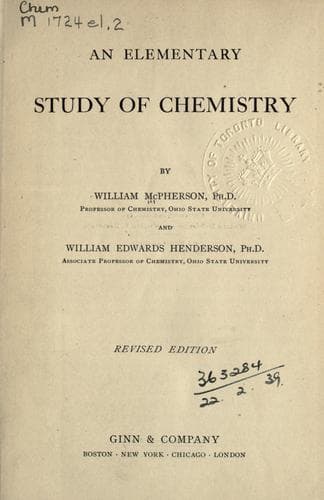
An Elementary Study of ChemistryMcPherson, William
Science
An Elementary Study of Chemistry
McPherson, William
Chemistry
1. What metals and compounds studied are prepared by electrolysis?
2. Write the equation for the reaction between aluminium and
hydrochloric acid; between aluminium and sulphuric acid (in two steps).
3. What hydroxides other than aluminium hydroxide have both acid and
basic properties?
4. Write equations showing the methods used for preparing aluminium
hydroxide and sulphate.
5. Write the general formula of an alum, representing an atom of an
alkali metal by X and an atom of a trivalent metal by Y.
6. What is meant by the term polysilicic acid, as used in the discussion
of aluminium silicates?
7. Compare the properties of the hydroxides of the different groups of
metals so far studied.
8. In what respects does aluminium oxide differ from calcium oxide in
properties?
9. Supposing bauxite to be 90% aluminium hydroxide, what weight of it is
necessary for the preparation of 100 kg. of aluminium?
CHAPTER XXVII
THE IRON FAMILY
===================================================================
| | | | |
| | | | APPROXIMATE |
| SYMBOL | ATOMIC | DENSITY | MELTING | OXIDES
| | WEIGHT | | POINT |
________|________|________|_________|_____________|________________
| | | | |
Iron | Fe | 55.9 | 7.93 | 1800 deg. | FeO, Fe_{2}O_{3}
Cobalt | Co | 59.0 | 8.55 | 1800 deg. | CoO, Co_{2}O_{3}
Nickel | Ni | 58.7 | 8.9 | 1600 deg. | NiO, Ni_{2}O_{3}
===================================================================
~The family.~ The elements iron, cobalt, and nickel form a group in the
eighth column of the periodic table. The atomic weights of the three are
very close together, and there is not the same gradual gradation in the
properties of the three elements that is noticed in the families in
which the atomic weights differ considerably in magnitude. The elements
are very similar in properties, the similarity being so great in the
case of nickel and cobalt that it is difficult to separate them by
chemical analysis.
The elements occur in nature chiefly as oxides and sulphides, though
they have been found in very small quantities in the native state,
usually in meteorites. Their sulphides, carbonates, and phosphates are
insoluble in water, the other common salts being soluble. Their salts
are usually highly colored, those of iron being yellow or light green as
a rule, those of nickel darker green, while cobalt salts are usually
rose colored. The metals are obtained by reducing the oxides with
carbon.
IRON
Public-domain text, read in full here on John Shaqi.
Reviews
Reviews
No reviews yet
Be the first to share your thoughts on this work.
Elsewhere in the archive
Join the Discussion
Join the discussion
Sign in to leave a comment or review.
Sign InorCreate an account