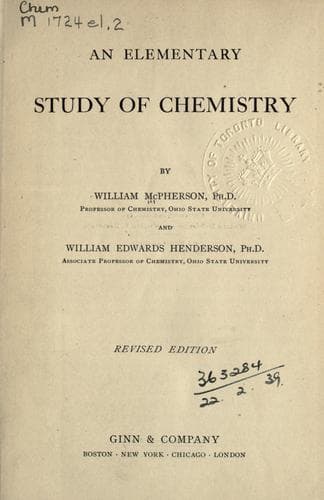
An Elementary Study of ChemistryMcPherson, William
Science
An Elementary Study of Chemistry
McPherson, William
Chemistry
~Ferric sulphate~ (Fe_{2}(SO_{4})_{3}). This compound can be made by
treating an acid solution of green vitriol with an oxidizing agent. It
is difficult to crystallize and hard to obtain in pure condition. When
an alkali sulphate in proper quantity is added to ferric sulphate in
solution an iron alum is formed, and is easily obtained in
large crystals. The best known iron alums have the formulas
KFe(SO_{4})_{2}.12H_{2}O and NH_{4}Fe(SO_{4})_{2}.12H_{2}O. They are
commonly used when a pure ferric salt is required.
~Ferric hydroxide~ (Fe(OH)_{3}). When solutions of ferric salts are
treated with ammonium hydroxide, ferric hydroxide is formed as a
rusty-red precipitate, insoluble in water.
~Iron cyanides.~ A large number of complex cyanides containing iron are
known, the most important being potassium ferrocyanide, or yellow
prussiate of potash (K_{4}FeC_{6}N_{6}), and potassium ferricyanide, or
red prussiate of potash (K_{3}FeC_{6}N_{6}). These compounds are the
potassium salts of the complex acids of the formulas H_{4}FeC_{6}N_{6}
and H_{3}FeC_{6}N_{6}.
~Oxidation of ferrous salts.~ It has just been seen that when a ferrous
salt is treated with an oxidizing agent in the presence of a free acid a
ferric salt is formed:
2FeSO_{4} + H_{2}SO_{4} + O = Fe_{2}(SO_{4})_{3} + H_{2}O.
In this reaction oxygen is used up, and the valence of the iron is
changed from 2 to 3. The same equation may be written
2Fe^{++}, 2SO_{4}^{--} + 2H^{+}, SO_{4}^{--} + O
= 2Fe^{+++}, 3SO_{4}^{--} + H_{2}O.
Hydrogen ions have been oxidized to water, while the charge of each iron
ion has been increased from 2 to 3.
In a similar way the conversion of ferrous chloride into ferric chloride
may be written
Fe^{++}, 2Cl^{-} + Cl = Fe^{+++}, + 3Cl^{-}.
Here again the valence of the iron and the charge on the iron ion has
been increased from 2 to 3, though no oxygen has entered into the
reaction. As a rule, however, changes of this kind are brought about by
the use of an oxidizing agent, and are called oxidations.
The term "oxidation" is applied to all reactions in which the valence of
the metal of a compound is increased, or, in other words, to all
reactions in which the charge of a cation is increased.
~Reduction of ferric salts.~ The changes which take place when a ferric
salt is converted into a ferrous salt are the reverse of the ones just
described. This is seen in the equation
FeCl_{3} + H = FeCl_{2} + HCl
In this reaction the valence of the iron has been changed from 3 to 2.
The same equation may be written
Fe^{+++}, 3Cl_{-} + H = Fe^{++}, + H^{+} + 3Cl_{-}
Public-domain text, read in full here on John Shaqi.
Reviews
Reviews
No reviews yet
Be the first to share your thoughts on this work.
Elsewhere in the archive
Join the Discussion
Join the discussion
Sign in to leave a comment or review.
Sign InorCreate an account