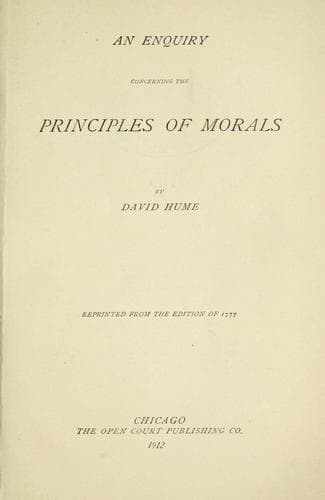
An Enquiry Concerning the Principles of Morals — John Shaqi
An Enquiry Concerning the Principles of MoralsHume, David
PhilosophyPhilosophy
An Enquiry Concerning the Principles of Morals
Hume, David
Conduct of life; Ethics
Upon the whole, then, it seems undeniable, THAT nothing can bestow more
merit on any human creature than the sentiment of benevolence in an
eminent degree; and THAT a PART, at least, of its merit arises from its
tendency to promote the interests of our species, and bestow happiness
on human society. We carry our view into the salutary consequences
of such a character and disposition; and whatever has so benign an
influence, and forwards so desirable an end, is beheld with complacency
and pleasure. The social virtues are never regarded without their
beneficial tendencies, nor viewed as barren and unfruitful. The
happiness of mankind, the order of society, the harmony of families, the
mutual support of friends, are always considered as the result of their
gentle dominion over the breasts of men.
How considerable a PART of their merit we ought to ascribe to their
utility, will better appear from future disquisitions; [Footnote: Sect.
III. and IV.] as well as the reason, why this circumstance has such a
command over our esteem and approbation. [Footnote: Sect. V.]
SECTION III. OF JUSTICE.
PART I.
THAT Justice is useful to society, and consequently that PART of its
merit, at least, must arise from that consideration, it would be a
superfluous undertaking to prove. That public utility is the SOLE origin
of justice, and that reflections on the beneficial consequences of this
virtue are the SOLE foundation of its merit; this proposition, being
more curious and important, will better deserve our examination and
enquiry.
Let us suppose that nature has bestowed on the human race such profuse
ABUNDANCE of all EXTERNAL conveniencies, that, without any uncertainty
in the event, without any care or industry on our part, every individual
finds himself fully provided with whatever his most voracious appetites
can want, or luxurious imagination wish or desire. His natural beauty,
we shall suppose, surpasses all acquired ornaments: the perpetual
clemency of the seasons renders useless all clothes or covering: the
raw herbage affords him the most delicious fare; the clear fountain,
the richest beverage. No laborious occupation required: no tillage: no
navigation. Music, poetry, and contemplation form his sole business:
conversation, mirth, and friendship his sole amusement. It seems evident
that, in such a happy state, every other social virtue would flourish,
and receive tenfold increase; but the cautious, jealous virtue of
justice would never once have been dreamed of. For what purpose make a
partition of goods, where every one has already more than enough? Why
give rise to property, where there cannot possibly be any injury? Why
call this object MINE, when upon the seizing of it by another, I need
but stretch out my hand to possess myself to what is equally valuable?
Justice, in that case, being totally useless, would be an idle
ceremonial, and could never possibly have place in the catalogue of
virtues.
Public-domain text, read in full here on John Shaqi.
Reviews
Reviews
No reviews yet
Be the first to share your thoughts on this work.
Join the Discussion
Join the discussion
Sign in to leave a comment or review.
Sign InorCreate an account