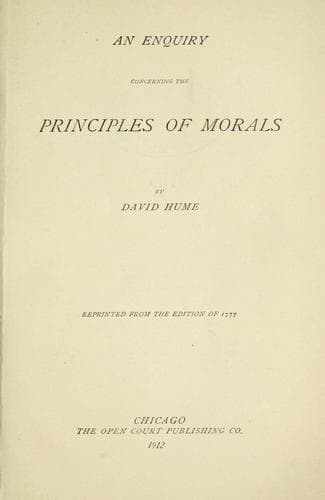
An Enquiry Concerning the Principles of MoralsHume, David
PhilosophyPhilosophy
An Enquiry Concerning the Principles of Morals
Hume, David
Conduct of life; Ethics
We see, even in the present necessitous condition of mankind, that,
wherever any benefit is bestowed by nature in an unlimited abundance,
we leave it always in common among the whole human race, and make no
subdivisions of right and property. Water and air, though the most
necessary of all objects, are not challenged as the property of
individuals; nor can any man commit injustice by the most lavish use and
enjoyment of these blessings. In fertile extensive countries, with few
inhabitants, land is regarded on the same footing. And no topic is so
much insisted on by those, who defend the liberty of the seas, as the
unexhausted use of them in navigation. Were the advantages, procured
by navigation, as inexhaustible, these reasoners had never had any
adversaries to refute; nor had any claims ever been advanced of a
separate, exclusive dominion over the ocean.
It may happen, in some countries, at some periods, that there be
established a property in water, none in land [Footnote: Genesis, chaps.
xiii. and xxi.]; if the latter be in greater abundance than can be used
by the inhabitants, and the former be found, with difficulty, and in
very small quantities.
Again; suppose, that, though the necessities of human race continue the
same as at present, yet the mind is so enlarged, and so replete with
friendship and generosity, that every man has the utmost tenderness for
every man, and feels no more concern for his own interest than for that
of his fellows; it seems evident, that the use of justice would, in
this case, be suspended by such an extensive benevolence, nor would the
divisions and barriers of property and obligation have ever been thought
of. Why should I bind another, by a deed or promise, to do me any
good office, when I know that he is already prompted, by the strongest
inclination, to seek my happiness, and would, of himself, perform the
desired service; except the hurt, he thereby receives, be greater than
the benefit accruing to me? in which case, he knows, that, from my
innate humanity and friendship, I should be the first to oppose myself
to his imprudent generosity. Why raise landmarks between my neighbour's
field and mine, when my heart has made no division between our
interests; but shares all his joys and sorrows with the same force and
vivacity as if originally my own? Every man, upon this supposition,
being a second self to another, would trust all his interests to the
discretion of every man; without jealousy, without partition, without
distinction. And the whole human race would form only one family; where
all would lie in common, and be used freely, without regard to property;
but cautiously too, with as entire regard to the necessities of each
individual, as if our own interests were most intimately concerned.
Public-domain text, read in full here on John Shaqi.
Reviews
Reviews
No reviews yet
Be the first to share your thoughts on this work.
Join the Discussion
Join the discussion
Sign in to leave a comment or review.
Sign InorCreate an account