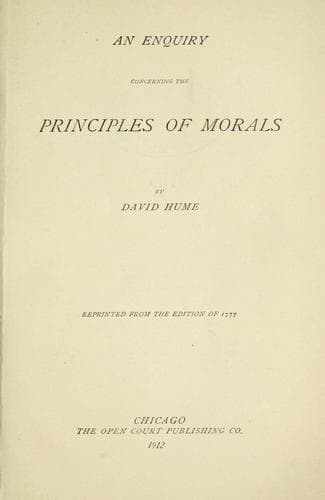
An Enquiry Concerning the Principles of MoralsHume, David
PhilosophyPhilosophy
An Enquiry Concerning the Principles of Morals
Hume, David
Conduct of life; Ethics
Were the human species so framed by nature as that each individual
possessed within himself every faculty, requisite both for his own
preservation and for the propagation of his kind: Were all society and
intercourse cut off between man and man, by the primary intention of the
supreme Creator: It seems evident, that so solitary a being would be
as much incapable of justice, as of social discourse and conversation.
Where mutual regards and forbearance serve to no manner of purpose,
they would never direct the conduct of any reasonable man. The headlong
course of the passions would be checked by no reflection on future
consequences. And as each man is here supposed to love himself alone,
and to depend only on himself and his own activity for safety and
happiness, he would, on every occasion, to the utmost of his power,
challenge the preference above every other being, to none of which he
is bound by any ties, either of nature or of interest. But suppose
the conjunction of the sexes to be established in nature, a family
immediately arises; and particular rules being found requisite for
its subsistence, these are immediately embraced; though without
comprehending the rest of mankind within their prescriptions. Suppose
that several families unite together into one society, which is totally
disjoined from all others, the rules, which preserve peace and order,
enlarge themselves to the utmost extent of that society; but becoming
then entirely useless, lose their force when carried one step farther.
But again suppose, that several distinct societies maintain a kind of
intercourse for mutual convenience and advantage, the boundaries of
justice still grow larger, in proportion to the largeness of men's
views, and the force of their mutual connexions. History, experience,
reason sufficiently instruct us in this natural progress of human
sentiments, and in the gradual enlargement of our regards to justice,
in proportion as we become acquainted with the extensive utility of that
virtue.
PART II.
If we examine the PARTICULAR laws, by which justice is directed,
and property determined; we shall still be presented with the same
conclusion. The good of mankind is the only object of all these laws
and regulations. Not only is it requisite, for the peace and interest
of society, that men's possessions should be separated; but the rules,
which we follow, in making the separation, are such as can best be
contrived to serve farther the interests of society.
Public-domain text, read in full here on John Shaqi.
Reviews
Reviews
No reviews yet
Be the first to share your thoughts on this work.
Join the Discussion
Join the discussion
Sign in to leave a comment or review.
Sign InorCreate an account