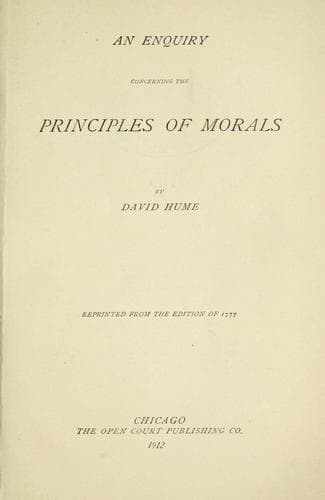
An Enquiry Concerning the Principles of MoralsHume, David
PhilosophyPhilosophy
An Enquiry Concerning the Principles of Morals
Hume, David
Conduct of life; Ethics
We shall suppose that a creature, possessed of reason, but unacquainted
with human nature, deliberates with himself what rules of justice or
property would best promote public interest, and establish peace and
security among mankind: His most obvious thought would be, to assign the
largest possessions to the most extensive virtue, and give every one
the power of doing good, proportioned to his inclination. In a perfect
theocracy, where a being, infinitely intelligent, governs by particular
volitions, this rule would certainly have place, and might serve to the
wisest purposes: But were mankind to execute such a law; so great is
the uncertainty of merit, both from its natural obscurity, and from the
self-conceit of each individual, that no determinate rule of conduct
would ever result from it; and the total dissolution of society must
be the immediate consequence. Fanatics may suppose, THAT DOMINION IS
FOUNDED ON GRACE, and THAT SAINTS ALONE INHERIT THE EARTH; but the civil
magistrate very justly puts these sublime theorists on the same footing
with common robbers, and teaches them by the severest discipline, that a
rule, which, in speculation, may seem the most advantageous to society,
may yet be found, in practice, totally pernicious and destructive.
That there were RELIGIOUS fanatics of this kind in England, during
the civil wars, we learn from history; though it is probable, that the
obvious TENDENCY of these principles excited such horror in mankind, as
soon obliged the dangerous enthusiasts to renounce, or at least conceal
their tenets. Perhaps the LEVELLERS, who claimed an equal distribution
of property, were a kind of POLITICAL fanatics, which arose from the
religious species, and more openly avowed their pretensions; as carrying
a more plausible appearance, of being practicable in themselves, as well
as useful to human society. It must, indeed, be confessed, that nature
is so liberal to mankind, that, were all her presents equally divided
among the species, and improved by art and industry, every individual
would enjoy all the necessaries, and even most of the comforts of life;
nor would ever be liable to any ills but such as might accidentally
arise from the sickly frame and constitution of his body. It must also
be confessed, that, wherever we depart from this equality, we rob the
poor of more satisfaction than we add to the rich, and that the slight
gratification of a frivolous vanity, in one individual, frequently costs
more than bread to many families, and even provinces. It may appear
withal, that the rule of equality, as it would be highly USEFUL, is not
altogether IMPRACTICABLE; but has taken place, at least in an imperfect
degree, in some republics; particularly that of Sparta; where it was
attended, it is said, with the most beneficial consequences. Not to
mention that the Agrarian laws, so frequently claimed in Rome, and
carried into execution in many Greek cities, proceeded, all of them,
Public-domain text, read in full here on John Shaqi.
Reviews
Reviews
No reviews yet
Be the first to share your thoughts on this work.
Join the Discussion
Join the discussion
Sign in to leave a comment or review.
Sign InorCreate an account