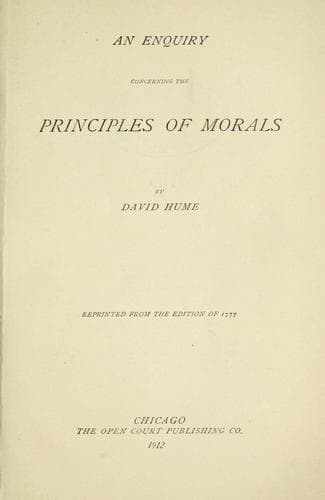
An Enquiry Concerning the Principles of MoralsHume, David
PhilosophyPhilosophy
An Enquiry Concerning the Principles of Morals
Hume, David
Conduct of life; Ethics
What alone will beget a doubt concerning the theory, on which I insist,
is the influence of education and acquired habits, by which we are
so accustomed to blame injustice, that we are not, in every instance,
conscious of any immediate reflection on the pernicious consequences of
it. The views the most familiar to us are apt, for that very reason,
to escape us; and what we have very frequently performed from certain
motives, we are apt likewise to continue mechanically, without
recalling, on every occasion, the reflections, which first determined
us. The convenience, or rather necessity, which leads to justice is so
universal, and everywhere points so much to the same rules, that the
habit takes place in all societies; and it is not without some scrutiny,
that we are able to ascertain its true origin. The matter, however,
is not so obscure, but that even in common life we have every moment
recourse to the principle of public utility, and ask, WHAT MUST BECOME
OF THE WORLD, IF SUCH PRACTICES PREVAIL? HOW COULD SOCIETY SUBSIST
UNDER SUCH DISORDERS? Were the distinction or separation of possessions
entirely useless, can any one conceive, that it ever should have
obtained in society?
Thus we seem, upon the whole, to have attained a knowledge of the force
of that principle here insisted on, and can determine what degree
of esteem or moral approbation may result from reflections on public
interest and utility. The necessity of justice to the support of society
is the sole foundation of that virtue; and since no moral excellence
is more highly esteemed, we may conclude that this circumstance of
usefulness has, in general, the strongest energy, and most entire
command over our sentiments. It must, therefore, be the source of
a considerable part of the merit ascribed to humanity, benevolence,
friendship, public spirit, and other social virtues of that stamp; as it
is the sole source of the moral approbation paid to fidelity, justice,
veracity, integrity, and those other estimable and useful qualities and
principles. It is entirely agreeable to the rules of philosophy, and
even of common reason; where any principle has been found to have a
great force and energy in one instance, to ascribe to it a like
energy in all similar instances. This indeed is Newton's chief rule of
philosophizing [Footnote: Principia. Lib. iii.].
SECTION IV.
OF POLITICAL SOCIETY.
Public-domain text, read in full here on John Shaqi.
Reviews
Reviews
No reviews yet
Be the first to share your thoughts on this work.
Join the Discussion
Join the discussion
Sign in to leave a comment or review.
Sign InorCreate an account