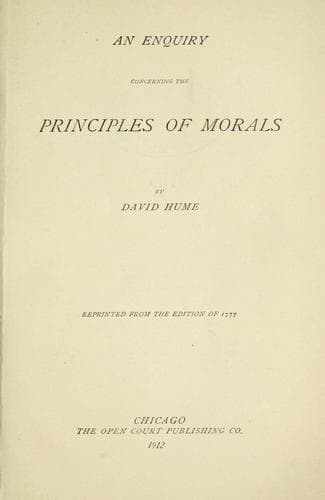
An Enquiry Concerning the Principles of MoralsHume, David
PhilosophyPhilosophy
An Enquiry Concerning the Principles of Morals
Hume, David
Conduct of life; Ethics
Had every man sufficient SAGACITY to perceive, at all times, the strong
interest which binds him to the observance of justice and equity, and
STRENGTH OF MIND sufficient to persevere in a steady adherence to a
general and a distant interest, in opposition to the allurements of
present pleasure and advantage; there had never, in that case, been any
such thing as government or political society, but each man, following
his natural liberty, had lived in entire peace and harmony with all
others. What need of positive law where natural justice is, of itself,
a sufficient restraint? Why create magistrates, where there never arises
any disorder or iniquity? Why abridge our native freedom, when, in every
instance, the utmost exertion of it is found innocent and beneficial?
It is evident, that, if government were totally useless, it never could
have place, and that the sole foundation of the duty of allegiance is
the ADVANTAGE, which it procures to society, by preserving peace and
order among mankind.
When a number of political societies are erected, and maintain a great
intercourse together, a new set of rules are immediately discovered to
be USEFUL in that particular situation; and accordingly take place under
the title of Laws of Nations. Of this kind are, the sacredness of the
person of ambassadors, abstaining from poisoned arms, quarter in war,
with others of that kind, which are plainly calculated for the ADVANTAGE
of states and kingdoms in their intercourse with each other.
The rules of justice, such as prevail among individuals, are not
entirely suspended among political societies. All princes pretend a
regard to the rights of other princes; and some, no doubt, without
hypocrisy. Alliances and treaties are every day made between independent
states, which would only be so much waste of parchment, if they were not
found by experience to have SOME influence and authority. But here is
the difference between kingdoms and individuals. Human nature cannot
by any means subsist, without the association of individuals; and that
association never could have place, were no regard paid to the laws of
equity and justice. Disorder, confusion, the war of all against all, are
the necessary consequences of such a licentious conduct. But nations
can subsist without intercourse. They may even subsist, in some degree,
under a general war. The observance of justice, though useful among
them, is not guarded by so strong a necessity as among individuals;
and the moral obligation holds proportion with the USEFULNESS. All
politicians will allow, and most philosophers, that reasons of state
may, in particular emergencies, dispense with the rules of justice, and
invalidate any treaty or alliance, where the strict observance of
it would be prejudicial, in a considerable degree, to either of the
contracting parties. But nothing less than the most extreme necessity,
it is confessed, can justify individuals in a breach of promise, or an
invasion of the properties of others.
Public-domain text, read in full here on John Shaqi.
Reviews
Reviews
No reviews yet
Be the first to share your thoughts on this work.
Join the Discussion
Join the discussion
Sign in to leave a comment or review.
Sign InorCreate an account