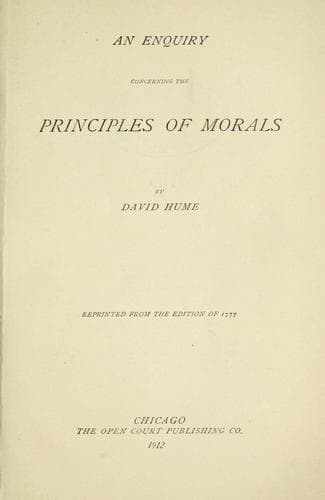
An Enquiry Concerning the Principles of MoralsHume, David
PhilosophyPhilosophy
An Enquiry Concerning the Principles of Morals
Hume, David
Conduct of life; Ethics
The ancient philosophers, though they often affirm, that virtue is
nothing but conformity to reason, yet, in general, seem to consider
morals as deriving their existence from taste and sentiment. On the
other hand, our modern enquirers, though they also talk much of the
beauty of virtue, and deformity of vice, yet have commonly endeavoured
to account for these distinctions by metaphysical reasonings, and by
deductions from the most abstract principles of the understanding. Such
confusion reigned in these subjects, that an opposition of the greatest
consequence could prevail between one system and another, and even in
the parts of almost each individual system; and yet nobody, till very
lately, was ever sensible of it. The elegant Lord Shaftesbury, who first
gave occasion to remark this distinction, and who, in general, adhered
to the principles of the ancients, is not, himself, entirely free from
the same confusion.
It must be acknowledged, that both sides of the question are susceptible
of specious arguments. Moral distinctions, it may be said, are
discernible by pure reason: else, whence the many disputes that reign in
common life, as well as in philosophy, with regard to this subject: the
long chain of proofs often produced on both sides; the examples cited,
the authorities appealed to, the analogies employed, the fallacies
detected, the inferences drawn, and the several conclusions adjusted to
their proper principles. Truth is disputable; not taste: what exists
in the nature of things is the standard of our judgement; what each
man feels within himself is the standard of sentiment. Propositions in
geometry may be proved, systems in physics may be controverted; but the
harmony of verse, the tenderness of passion, the brilliancy of wit, must
give immediate pleasure. No man reasons concerning another's beauty; but
frequently concerning the justice or injustice of his actions. In every
criminal trial the first object of the prisoner is to disprove the facts
alleged, and deny the actions imputed to him: the second to prove, that,
even if these actions were real, they might be justified, as innocent
and lawful. It is confessedly by deductions of the understanding, that
the first point is ascertained: how can we suppose that a different
faculty of the mind is employed in fixing the other? On the other hand,
those who would resolve all moral determinations into sentiment,
may endeavour to show, that it is impossible for reason ever to draw
conclusions of this nature. To virtue, say they, it belongs to be
amiable, and vice odious. This forms their very nature or essence. But
can reason or argumentation distribute these different epithets to any
subjects, and pronounce beforehand, that this must produce love,
and that hatred? Or what other reason can we ever assign for these
affections, but the original fabric and formation of the human mind,
which is naturally adapted to receive them?
Public-domain text, read in full here on John Shaqi.
Reviews
Reviews
No reviews yet
Be the first to share your thoughts on this work.
Join the Discussion
Join the discussion
Sign in to leave a comment or review.
Sign InorCreate an account