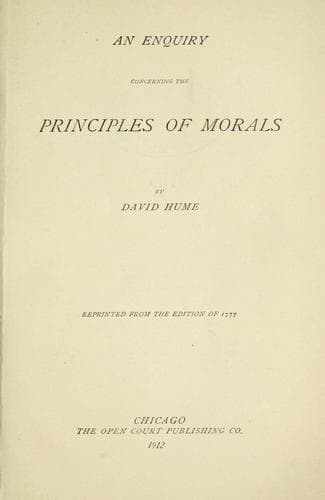
An Enquiry Concerning the Principles of MoralsHume, David
PhilosophyPhilosophy
An Enquiry Concerning the Principles of Morals
Hume, David
Conduct of life; Ethics
Those who live in the same family have such frequent opportunities of
licence of this kind, that nothing could prevent purity of manners, were
marriage allowed, among the nearest relations, or any intercourse of
love between them ratified by law and custom. Incest, therefore, being
PERNICIOUS in a superior degree, has also a superior turpitude and moral
deformity annexed to it.
What is the reason, why, by the Athenian laws, one might marry a
half-sister by the father, but not by the mother? Plainly this:
The manners of the Athenians were so reserved, that a man was never
permitted to approach the women's apartment, even in the same family,
unless where he visited his own mother. His step-mother and her children
were as much shut up from him as the woman of any other family, and
there was as little danger of any criminal correspondence between them.
Uncles and nieces, for a like reason, might marry at Athens; but neither
these, nor half-brothers and sisters, could contract that alliance at
Rome, where the intercourse was more open between the sexes. Public
utility is the cause of all these variations.
To repeat, to a man's prejudice, anything that escaped him in private
conversation, or to make any such use of his private letters, is highly
blamed. The free and social intercourse of minds must be extremely
checked, where no such rules of fidelity are established.
Even in repeating stories, whence we can foresee no ill consequences
to result, the giving of one's author is regarded as a piece of
indiscretion, if not of immorality. These stories, in passing from hand
to hand, and receiving all the usual variations, frequently come about
to the persons concerned, and produce animosities and quarrels among
people, whose intentions are the most innocent and inoffensive.
To pry into secrets, to open or even read the letters of others, to
play the spy upon their words and looks and actions; what habits more
inconvenient in society? What habits, of consequence, more blameable?
This principle is also the foundation of most of the laws of good
manners; a kind of lesser morality, calculated for the ease of company
and conversation. Too much or too little ceremony are both blamed, and
everything, which promotes ease, without an indecent familiarity, is
useful and laudable.
Constancy in friendships, attachments, and familiarities, is
commendable, and is requisite to support trust and good correspondence
in society. But in places of general, though casual concourse, where
the pursuit of health and pleasure brings people promiscuously together,
public conveniency has dispensed with this maxim; and custom there
promotes an unreserved conversation for the time, by indulging the
privilege of dropping afterwards every indifferent acquaintance, without
breach of civility or good manners.
Public-domain text, read in full here on John Shaqi.
An Enquiry Concerning the Principles of Morals — John Shaqi
Reviews
Reviews
No reviews yet
Be the first to share your thoughts on this work.
Join the Discussion
Join the discussion
Sign in to leave a comment or review.
Sign InorCreate an account